View allAll Photos Tagged Battery Scrap Buyer
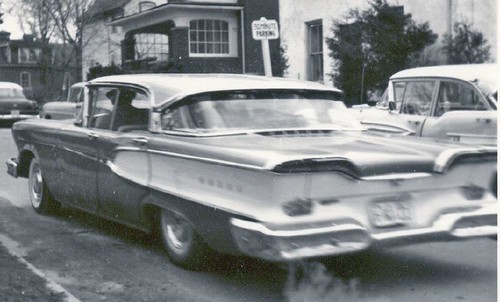
Here's a link to how this same Edsel looked in 1959. I took this picture with my Brownie Hawkeye when I was thirteen.
farm2.static.flickr.com/1286/544933741_8e82112e81.jpg
A bit busy today and tomorrow, but will try to visit everyone's stream. Thanks for your patience
When my stepfather first met my mother in 1959, he was driving a brand new 1958 Ford Edsel. At that time it was touted as being far ahead of its time. The big feature was the ability of the driver to shift gears by pushing buttons on a touch pad in the centre of the steering wheel.
After a few years the Edsel was abandoned. It had become an embarrassment to Ford. The button shift did not live up to its potential, and was notorious for losing its timing. It sometimes took up to five seconds from the time you pushed a button until the time the transmission shifted, usually with a jolting 'thunk'. Further, the Edsel was an overly heavy car, even in an age of heavy cars.
I did drive it a fair bit over a ten year period, and it could be scary at times.
Over the years I wondered what happened to it. I couldn't remember it being traded in. Then, several years ago, I spotted it in the farm yard at my brother, Steve's, place. it was pretty badly smacked up, and had been used for .22 practice. I always meant to photograph it, but didn't get a chance until yesterday. It had been towed about fifty feet from where I originally saw it, and the tow had not been kind.
From my set entitled “Steve and Marg’s Farm”
www.flickr.com/photos/21861018@N00/sets/72157608031549391/
In my collection entitled “Places”
www.flickr.com/photos/21861018@N00/collections/7215760074...
In my photostream
www.flickr.com/photos/21861018@N00/
The Story of the Edsel
(taken from Wikipedia, the free encyclopedia)
The Edsel was a marquee division of Ford Motor Company during the 1958, 1959 and 1960 model years.
In the early 1950s, the Ford Motor Co. became a publicly traded corporation that was no longer entirely owned by members of the Ford family. They were then able to sell cars according to then-current market trends following the sellers' market of the postwar years. The new management compared the roster of Ford makes with that of General Motors, and noted that Lincoln competed not with Cadillac, but with Oldsmobile. Since Ford had an excess of money on hand from the success of the Ford Thunderbird the plan was developed to move Lincoln upmarket with the Continental at the top, and to add another make to the intermediate slot vacated by Lincoln. Research and development had begun in 1955 under the name "E-car," which stood for "Experimental car." This represented a new division of the firm alongside that of Ford itself and the Lincoln-Mercury division, whose cars at the time shared the same body.
The Edsel was introduced amidst considerable publicity on "E Day"—September 4, 1957. It was promoted by a top-rated television special, The Edsel Show on October 13, but it was not enough to counter the adverse public reaction to the car's styling and conventional build. For months Ford had been circulating rumours that led consumers to expect an entirely new kind of car when in reality the Edsel shared its bodywork with other Ford models.
The Edsel was to be sold through a new Ford division. It existed from November 1956 until January 1958, after which Edsels were made by the Mercury-Edsel-Lincoln division (referred to as M-E-L). Edsel was sold through a new network of 1,500 dealers. This briefly brought total dealers of all Ford products to 10,000. Ford saw this as a way to come closer to parity with the other two companies of the Big Three: Chrysler had 10,000 dealers and General Motors had 16,000. As soon as it became apparent that the Edsels were not selling, many of these dealers added Lincoln-Mercury, English Ford and/or Taunus dealerships to their lines with the encouragement of Ford Motor Company. Some dealers, however, closed.
For the 1958 model year, Edsel produced four models, including the larger Mercury-based Citation and Corsair, and the smaller Ford-based Pacer and Ranger. The Citation came in two-door and four-door hardtops and two-door convertible versions. The Corsair came in two-door and four-door hardtop versions. The Pacer came in two-door and four-door hardtops, four-door sedan, and two-door convertible. The Ranger came in two-door and four-door hardtop or sedan versions. The four-door Bermuda and Villager wagons and the two-door Roundup wagon were based on the 116" wheelbase Ford station wagon platform and shared the trim and features of the Ranger and Pacer models. It included several innovative features, among which were its "rolling dome" speedometer and its Teletouch transmission shifting system in the center of the steering wheel. Other design innovations included an ergonomically designed controls for the driver, and self-adjusting brakes (often claimed as a first for the industry, although Studebaker had pioneered them earlier in the decade).
In the first year, 63,110 Edsels were sold in the U.S. with another 4,935 sold in Canada. Though below expectations, it was still the second largest car launch for any brand to date, second only to the Plymouth introduction in 1928.
For the 1959 model year, there were only two Edsels: the Ranger and the Corsair. The two larger cars were not produced. The new Corsair came in two-door and four-door hardtops, four-door sedan, and two-door convertible. The Ranger came in two-door and four-door hardtops, two-door and four-door sedans, and the Villager station wagon. In the 1959 model year, 44,891 cars were sold in the U.S., with an additional 2,505 sales in Canada.
For the 1960 model year, Edsel's last, only the Ranger and Villager were produced. The 1960 Edsel, in its final model year, emerged as a Ford. Its grill, hood, and four taillights, along with its side sweep spears, were the only real differences separating the Edsel from the Ford.
Ford announced the end of the Edsel program on Thursday, November 19, 1959. However, cars continued being produced until late in November, with the final tally at 2,846 1960 models. Total sales were approximately 84,000, less than half McNamara's projected break-even point. The company lost $350 million on the venture [1].
On Friday, November 20, United Press International's (UPI) wire service reported that book values for used Edsels had decreased by as much as $400 [approximately $2800 in 2006 dollars] (based on condition and age) immediately following the Ford press release. In some newspaper markets, dealers scrambled to renegotiate newspaper advertising contracts involving the 1960 Edsel models, while others dropped the name from their dealership's advertising "slugs." Ford issued a statement that it would distribute coupons to consumers who purchased 1960 models (and carryover 1959 models) prior to the announcement, valued at $300 to $400 towards the purchase of new Ford products to offset the decreased values. The company also issued credits to dealers for stock unsold or received, following the announcement.
There is no single reason why the Edsel failed, and failed so spectacularly. Popular culture often faults the car’s styling. Consumer Reports cited poor workmanship. Marketing experts hold the Edsel up as a supreme example of corporate America’s failure to understand the nature of the American consumer. Business analysts cite the weak internal support for the product inside Ford’s executive offices. According to author and Edsel scholar Jan Deutsch, the Edsel was "the wrong car at the wrong time."
One popular misconception was that the Edsel was an engineering failure, or a lemon, although it shared the same general reliability of its sister Mercury and Ford models that were built in the same factories. The Edsel is most famous for being a marketing disaster. Indeed, the name Edsel came to be synonymous with commercial failure, and similar ill-fated products have often been colloquially referred to as Edsels. Since it was such a debacle, it provided a case study for marketers on how not to market a product. The main reason the Edsel's failure is so famous was that it flopped despite Ford’s investment of $400,000,000 in its development.
The prerelease advertising campaign touted the car as having "...more YOU ideas," and the teaser advertisements in magazines only revealed glimpses of the car through a highly blurred lens or wrapped in paper or under tarps. Edsels were shipped to the dealerships undercover and remained wrapped on the dealer lots.
But the public also had a hard time understanding what the Edsel was, mostly because Ford made the mistake of pricing the Edsel within Mercury’s market price segment. Theoretically, the Edsel was conceived to fit into Ford’s marketing plans as the brand slotted in between Ford and Mercury. However, when the car arrived in 1958, its least expensive model—the Ranger—was priced within $73 of the most expensive and best-trimmed Ford sedan and $63 less than Mercury’s base Medalist model. In its midrange pricing, Edsel's Pacer and Corsair models were more expensive than their Mercury counterparts. Edsel's top-of-the-line Citation four door hardtop model was the only model priced to correctly compete with Mercury’s mid-range Montclair Turnpike Cruiser model.
Not only was the Edsel competing against its own sister divisions, but model for model, consumers did not understand what the car was supposed to be—a step up or a step below the Mercury.
After its introduction to the public, the Edsel did not live up to its overblown hype, even though it did have many new features, such as self-adjusting rear brakes and automatic lubrication. While consumer focus groups had said these and other features would make the "E" car attractive to them as car buyers, the cost of the cars outstripped what the public was willing to pay. When many potential buyers saw the base price tag, they simply left the dealership, and others were frightened by the price for a fully loaded, top of the line model.
One of the external forces working against the Edsel that Ford had no control over was the onset of the recession in late 1957.
When the Edsel was in its planning stages in the early and mid-1950s, the American economy was robust and growing. However, in the years that spanned the planning to its introduction, an economic recession hit, and American consumers not only shifted their idea of what an ideal car should be; in prior economic downturns, buyers flocked to the lower price marques like Plymouth, Chevrolet, and Ford. But in 1958, even these cars were perceived by some as unnecessarily large, and while the compact Rambler saw itself shoot to the third best selling make, none of the Big Three had anything compact to sell except their European cars built for Vauxhall, Simca, and Opel. The compacts introduced by the Big Three in 1960 were the direct result of the recession of 1958.
Compounding Edsel's problems was that the car had to appeal to buyers of other well established nameplates from the Big Three, such as Pontiac, Oldsmobile, Dodge, DeSoto, and even its internal sister division, Mercury -- itself never a stellar sales success.
Even if the 1958 recession hadn't hit when it did, the Edsel was entering into a shrinking marketplace. While Ernest Breech convinced Ford management that this market segment offered great untapped opportunity in the early 1950s, when the "E" car was in its earliest stages, by 1957, independent manufacturers in the mid-price field were drifting towards insolvency. Hoping to turn around their losses, Packard acquired Studebaker, yet the venerable Packard was no longer produced after 1958. On the other hand, American Motors changed its focus to the compact Rambler models, while their pre-merger brands (Nash and Hudson) were discontinued after the 1957 model year. Even Chrysler saw sales of its DeSoto marque drop dramatically from its 1957 high by over 50% in 1958. Following a disastrous 1959 model year, plans were made in Highland Park to discontinue DeSoto during its 1961 model year run.
Thus, the large, expensive Edsel that was planned to be all things to all people suddenly stood for excess, not progress.
The name of the car, Edsel, is also often cited as a further reason for its unpopularity. Naming the vehicle after Edsel Ford was proposed early in its development. However, the Ford family strongly opposed its use, Henry Ford II stating that he didn't want his father's good name spinning around on thousands of hubcaps. Ford also ran internal studies to decide on a name and even dispatched employees to stand outside movie theaters to poll audiences as to what their feelings were on several ideas. They reached no conclusions.
Ford hired the advertising firm Foote, Cone and Belding to come up with a name. However, when the advertising agency issued its report, citing over 6,000 possibilities, Ford's Ernest Breech commented that they had been hired to develop a name, not 6,000. Early favorites for the name brand included Citation, Corsair, Pacer, and Ranger, which were ultimately chosen for the vehicle's series names.
David Wallace, Manager of Marketing Research, and coworker Bob Young unofficially invited poet Marianne Moore for input and suggestions. Moore's unorthodox contributions (among them "Utopian Turtletop," "Pastelogram," and "Mongoose Civique") were meant to stir creative thought and were not officially authorized or contractual in nature. History has greatly exaggerated her relationship to the project.
At the behest of Ernest Breech, who was chairing a meeting in the absence of Henry Ford II, the car was finally called "Edsel" in honor of Edsel Ford, former company president and son of Henry Ford. Marketing surveys later found the name was thought to sound like the name of a tractor (Edson) and therefore was unpopular with the public.
Moreover, several consumer studies showed that people associated the name "Edsel" with "weasel" and "dead cell" (dead battery), drawing further unattractive comparisons.
Perhaps the most important factor in the Edsel's failure, however, was that when the car was introduced, the U.S. was entering a period of recession. Sales for all car manufacturers, even those not introducing new models, were down; consumers entered a period of preferring less expensive, more fuel-efficient automobiles.
Edsels were fast, but required premium gas and did not have the fuel economy desired during a recession. Mechanics disliked the bigger engine because of its unique design. The cylinder head had no combustion chamber and was perfectly flat, with the head set at an angle and "roof" pistons forming both a squish zone on one side and a combustion chamber on the other, meaning that the combustion took place entirely within the cylinder bore. This design reduced the cost of manufacture and possibly carbon buildup, but appeared strange to mechanics.
There were also reports of mechanical flaws in the models originating in the factory, due to lack of quality control and confusion of parts with other Ford models. Edsels in their first (1958) model year were made in both Mercury and Ford factories; the longer wheelbase models, Citation and Corsair, were produced alongside the Mercury products, and the shorter wheelbase models, Pacer and Ranger, were produced alongside the Ford products. There was never a stand-alone Edsel factory devoted solely to Edsel model production; workers making Fords and Mercurys literally had to change parts bins and tools to assemble extra Edsels once their hourly quota of regular Fords and Mercurys was achieved. As such, the desired quality control of the different Edsel models was difficult to attain for the new make of car. Many Edsels left the line unfinished, with the extra parts having been put into the trunks, with assembly instructions for the mechanics at the dealerships.
The Edsel is best remembered for its trademark "horsecollar" grille, which made it stand out from other cars of the period. A widely circulated wisecrack at the time was that "It looked like an Oldsmobile sucking on a lemon." Men often referred to the horsecollar grille as being akin to a woman’s genitalia. In fact, Robin Jones, a Ford designer at the time, later recalled that someone in the design studio - presumably as a cruel joke - actually taped hair to the inside of the grille area on one of the clay models produced during the design process; the end result, according to Jones, "looked like a hormonally-disturbed cow after giving birth."
Jokes aside, the front of the original Edsel turned out nothing like what was originally intended. Roy Brown, the original chief designer on the project, wanted a slender, almost delicate opening in the center; engineers, fearing engine cooling problems, vetoed the intended design, which led to the "horsecollar." The vertical grille theme, while improved for the 1959 models, was discontinued for the 1960 models, which were almost indistinguishable from Ford models of the same year, although the new front-end design bore no small resemblance to that of the 1959 Pontiac.
Many drivers disliked having the automatic transmission as pushbuttons (above) mounted on the steering wheel hub: this was the traditional location of the horn, and drivers ended up shifting gears instead of honking the horn. While the Edsel was fast, the location of the transmission pushbuttons was not conducive to street racing. There were jokes about stoplight dragsters and the buttons: D for Drag, L for Leap, and R for Race (instead of Drive, Low and Reverse).
There were also complaints about the taillights on 1958-model Edsel station wagons, which were boomerang-shaped and placed in a reverse fashion; at a distance, they appeared as arrows pointed in the opposite direction of the turn being made. While the left turn signal blinked, its arrow shape pointed right, and vice versa. However, there was little that could be done to give the Ford-based station wagons a unique appearance from the rear; corporate management insisted that no sheetmetal could be changed. Only the taillights and trim could be touched.
While the car and Ford’s planning of the car are the most often cited reasons for its failure, internal politics within the executive offices at Ford are as much to blame for the failure of the Edsel. Following World War II, Henry Ford II brought on Robert McNamara as one of the "whiz kids" to help turn Ford around. McNamara’s cost cutting and cost containment skills helped Ford emerge from its near collapse after the war. As such, McNamara eventually assumed a great deal of power at Ford. In many ways, McNamara was very much like Henry Ford: both men were committed to Ford above all other things and had little use for Continental, Lincoln, Mercury, and Edsel brand cars made by the company.
McNamara was against the formation of the separate divisions for Continental, Lincoln, Mercury, and Edsel cars, and moved to consolidate Lincoln, Mercury, and Edsel into the M-E-L division. McNamara saw to it that the Continental program was canceled and that the model was merged into the Lincoln range for 1958. He next set his sights on Edsel by maneuvering for elimination of the dual wheelbases and separate body used in 1958; instead, the Edsel would share the Ford platform and use Ford’s inner body structure for 1959. In 1960, the Edsel emerged as a Ford with different trim. McNamara also moved to reduce Edsel’s advertising budget for 1959, and for 1960, he virtually eliminated it. The final blow came in the fall of 1959, when McNamara convinced Henry Ford II and the management structure that the Edsel was doomed and that it was time to end production before the Edsel bled the company dry. (Note: McNamara also attempted to end the Lincoln nameplate; however, that effort ended with Elwood Engel's now classic redesign of 1961.) McNamara left Ford when he was named Secretary of Defense by President John F. Kennedy.
During the 1964 presidential election, Republican nominee Barry Goldwater blamed McNamara, then Secretary of Defense, for the Edsel's failure. Eventually, Ford's former executive vice president and financial contributor to Goldwater's campaign Ernest R. Breech wrote the Senator's campaign explaining that "Mr. McNamara ... had nothing to do with the plans for the Edsel car or any part of the program." However, the charge continued to be leveled against McNamara for years. During his time as head of the World Bank he instructed his public affairs officer to distribute copies of Breech's letter to the press whenever the accusation was made.[2]
The scheduled 1960 Edsel Comet compact car was hastily rebranded the Comet and assigned to Mercury dealerships. The Comet was an instant success, selling more cars in its first year than all models of Edsel produced during its three-year run. Styling touches seen in the Comets sold to the public that allude to being part of the Edsel family of models included the instrument cluster, rear tailfins (though canted diagonally), and the taillight shape (the lens is visually similar to that used on the 1960 Edsel, and even retained the embossed "E" code). The Comet's keys were even shaped like Edsel keys, with the center bar removed from the "E" to form a "C." For 1962, Ford officially assigned the Comet to the Mercury brand.
As the Edsel was a large commercial failure, the name became a popular joke in various media. A backronym, "Every Day Something Else Leaks", was inspired by the car's failure. Television programs, cartoons, video games, and films have all used the Edsel as humor, usually as a quick joke or as a sight gag.
In May 1958, then Vice President Richard Nixon was on a trip to Peru, riding in an Edsel convertible, when he was pelted with eggs and tomatoes by demonstrators. Nixon later joked: "They were throwing eggs at the car, not me."[3]
Fifty years after its spectacular failure, Edsel has become a highly collectible item amongst vintage car hobbyists. Fewer than 6,000 Edsels survive and are considered collectors’ items. A mint 1958 Citation convertible sometimes sells for over $100,000,[1] while rare models, like the 1960 convertible, may price up to $200,000. While the design was considered "ugly" fifty years ago, many other car manufacturers, such as Pontiac and Alfa Romeo, have employed similar vertical grille successfully on their car designs.
Many of the Edsel's features, such as transmission lock on ignition, adjustable brakes, gear selection as steering wheel buttons etc, which were considered "too impractical" in the late 1950s, are today standard features of sports cars.
Post Processing:
Topaz Add-On: Vibrance (HDR)
PhotoShop Elements 5: posterization, rough pastel, accented edges, ink outlines
By the end of 1987, New Jersey Transit was selling off their remaining E8a locomotives. Of the sale lot, two of the locomotives were found to be best of shape for restoration and easily made operational for service. These locomotives were NJT EMD E8a #4334, ex-Southern Railway #6913 and NJT EMD E8a #4305, ex-PRR #5702A. The fate of former NJT #4334 in this photo…and a few other photos will be posted on my FLICKR site for viewing.
NJT #4334 was purchased by Gary Fairbanks, who was an avid railroad enthusiast. Initial plans at the time was to restore the locomotive to operational and use condition.
Some history thereafter - During this period in the mid-80’s, the Susquehanna Valley Railway Historical Society, Inc., NRHS Chapter (SVRHS) was looking in obtaining some key railroad rolling stock significant to our local railroad history and to hopefully one day have a railroad museum located at or around the former Lackawanna Binghamton, NY Station. How this developed was when Conrail sold the Binghamton Station to Architects Jim Bryden and Peter Trozze in 1984. The Station sat empty for years when the last Erie Lackawanna passenger service ended on a cold wintery night in the early hours of January, 5, 1970. Over the years the Station being somewhat empty and dormant began to takes in toll by weather, neglect, just short of becoming wrecking ball status…well, not quite yet. Inside the Lackawanna Station, the Union News Company news stand was located in the main lobby waiting area that sold the normal items to passengers as newspapers, smokes, candies, etc. during the golden years or rail travel. After passenger service was discontinued, negations between SVRHS and owner of the newsstand, Ancorp National, Inc. of New York, took place resulting in the donation and title of the newsstand to SVRHS….thus, SVRHS being a historical group and affiliated with a National Railway Historical Society, it would somewhat make it - I’d say harder to demolish the Station…basically, SVRHS was the savor keeping the Station at time from being torn down.
For new owners Bryden and Trozze, in order to take full deed ownership of the Station, SVRHS had to relinquish ownership of the Union Newsstand. In exchange, a lease agreement was made in turn to occupy the former DL&W Utica/Syracuse branch passenger tracks located on the east side of the station consisting of 4 passenger holding tracks with 2 tracks able to access to the main line. Conveniently located next to this site, former last remaining Marconi Tower still stands (non-active) and the old steam boiler building used to create steam heat for passenger cars is there, but empty. Overall, a good setting for a railroad themed museum.
A complete restoration of the Lackawanna Station was underway with offices and retail space planned. SVRHS having ties with Conrail management, was able to secure two remaining Erie Stillwell coaches stored in the Elmira, NY and have then moved (by the ghost train) to our Binghamton planned museum site at the Station. A Erie camp car and Erie boxcar left behind from years past became part of the sale of the Station with new owners taking ownership. These were allowed for use to SVRHS to use as needed. As the Station site filled with period rolling stock, another opportunity came to secure Conrail #21104 (ex-E-L C316, former Erie 304) bay window caboose, donated and delivered by Conrail, February 1987, and another donation from Delaware Otsego System, Cooperstown & Charlotte Valley Railroad (ex-CNJ believed to have been used by Barbara Streisand in “Funny Girl”) combine car to SVRHS.
The Lackawanna Station grand opening ceremonies took place October 18,1986 with City of Binghamton Mayor Juanita Crabb, new owners, and other noted dignitaries present and “The Station Square” was now the new place to be again. As part of the City’s overall Binghamton revitalization plan, the Station and surrounding area was classified as the “Railroad Terminal Historic District”, consisting of 19 buildings of which four were passenger and freight operations, and make available funding for restoration and revitalizing efforts.
SVRHS was now well already underway in restoration and cosmetic needs for our railroad museum displays. Work underway: Clean and repaint Conrail caboose to Erie Lackawanna C316 colors * one Erie Stillwell was gutted, cleaned, painted, and broken windows replaced - the other Stillwelll undecided disposition * Move SVRHS retail sales from Station in the Union Newsstand and relocated to the Camp Car * boxcar was for storage of work equipment and supplies * Combine car was slightly hurt from being moved around the yards making it not feasible for restoration. Disposition was for Whippany Railway Museum to salvage any usable parts for their use before final disposition.
Enter NJT #4334. Negotiations between owner Gary Fairbanks and SVRHS began late 1987 for possible movement of the locomotive from NJT to SVRHS proposed Binghamton Lackawanna Station museum site. One main factor for choice the owner had no place to store the unit at time of purchase, and with the Station site to be a proposed museum, it was a perfect fit. As part of the lease agreement, the owner would be responsible for making the locomotive operational and suitable for excursion service. In return, SVRHS would be responsible for the storage area needs and paint the locomotive of our choice and road name. The E8a was one of the only two in the NJT “disco paint scheme” and arrived in tow by Conrail on Leap Day, February 1988. This was indeed a great moment for SVRHS and a perfect fit for our proposed museum.
Shortly after the E8a arrived and spotted in the Station site, Gary Fairbanks-owner, and his partner Pete performed an inspection of the locomotive. Overall, the locomotive was found easily restorable to operation needing: battery : windshields : an air brake part : some minor governor work : some cab gages : general grease and lube needs : cosmetic repair with a paint job. Plans were to have the locomotive operational by 4th of July, same year. In parallel, the Central Chapter NRHS in Syracuse was underway with their restoration on their NJT E8a Plans between both Chapters were to paint the locomotives in the Lackawanna passenger scheme with the Binghamton unit numbered #807 and the Syracuse unit numbered #808… and both units run some excursions together hosted by both groups.
But things went astray for the proposed museum site and the E8a in Binghamton, and it went from from worse to more worse. Efforts by the owner fell through mothballing the locomotive to operational by means unknown. Funding the City was going to allocate for the Railroad Terminal Historic District was never approved by the city council. Vandals and transients were finding the equipment site a new place to live and cause damage taking a toll on the equipment restoration efforts. Then in early 1990, announcement was made the City was acquiring the former Lackawanna Freight House adjacent to Lackawanna Station and our equipment site, Proposed was to build a 6,012 seat Binghamton Municipal Baseball Stadium with construction to begin in July 1991 once announced the Williamsport Bills would be moving from Williamsport, Pennsylvania. The new stadium would be home to a Double-A Mets team. Architect’s for the stadium were the owners of the Binghamton Lackawanna Station. As construction began, initial plans would sever one of the two lead tracks from our equipment site leaving now only one track for mainline access. SVRHS maneuvered equipment accordingly to allow best use equipment and locomotive to the mainline access track. Shortly after this task, SVRHS was contacted again and advise the new outfield guidelines called for further depth of the outfield to be needed. This would now sever our only access to the mainline track and make our equipment landlocked since no monies were available to make a new connection to the main line.
Then in September 1995, a late evening phone call by the Police our equipment was on fire as result of suspected transient(s) sleeping in the Erie Stillwell car. The fire totally destroyed the Stillwell and mostly the Combine coach. The camp car and boxcar partially scorched on the inside (one) wall and the Stillwell being restored was unharmed. The locomotive and caboose escaped any damage. Unfortunately several gallons of expensive special Dupont paint primer stored in the boxcar to be used on the locomotive repaint was damaged-unusable. The Stillwell and Combine were later scrapped for salvage that winter.
In 1998, SVRHS was notified the Lackawanna Station was going up For Sale. Disagreements between owners Bryden & Trozze Architects resulted in the separation of Station ownership and business partnership . The Station would still stay viable for current tenant businesses and the SVRHS rolling stock site until sale of the Station. SVRHS was now faced with and imposing problem….what to do with all the railroad rolling stock, locomotive, and small archives room housed n the Station basement if new Station owner asks us to vacate. Then in 2003, a young New York City entrepreneur, Ari Meisel, purchased many of the buildings in the Railroad Terminal Historic District to include the Station. His dream for the Station passenger service would be restored some day making the Station vital for his future plans….but notation by Ari, if the right buyer and price were offered for the Station, he would sell.
As years passed, SVRHS invested money, time, and fruits of labor to maintain restoration efforts on the rolling stock. Continued efforts to contact the owner of the E8a locomotive were fruitless. The new windshield inserted in the locomotive with smashed by vandals, rust was now the new paint job, and someone(s) forcibly broke into the locomotive and stole several key components off the motor….they knew what they wanted. Interest was rapidly declining to maintain the rolling stock, restoration work was now a money pit, and Mother Nature was always one step ahead to thwart cosmetic accomplishments. Then with a bang of the gavel, decision was made by SVRHS to begin the process of liquidating the equipment site and finding a new home for all.
Disposition of railroad rolling stock went well. The caboose was road worthy for shoreline or tourist type use. On June 9, 1999, the Leatherstocking Historical Society, NRHS took full ownership and prepped for removal by a flatbed truck to be used on their budding shortline tourist railroad, Cooperstown & Charlotte Railroad. In March 1999, Chemung Valley Railway Historical Society of Elmira, NY, took ownership of the Erie Stillwell with plans moving it to their Elmira site. Since the Erie camp car and Erie boxcar were owned by former Lackawanna Station owners Bryden & Trozze, CVRHS decided to negotiate a deal with them before making any final preparations removing anything from the Station site to Elmira. Disposition of the locomotive was still in limbo since owner Gary Fairbanks was still working privately with his plan. But problems still mounted. The rolling stock was not railroad code for transport by rail, but the locomotive trucks and wheel sets were earlier approved a few years back to meet FRA approval. Costs for flatbed truck removal of the rolling stock, prep for travel, insurance, etc, were much higher than expected. This ultimately left almost a final decision that if nothing could be finalized for removing the rolling stock or locomotive from site, they would need to be cut up and scrapped on site for salvage value. But, the Good Fairy arrived. The CVRHS was able to work a deal with the New York, Susquehanna and Western Railway (NYS&W) to move all the equipment to their property temporarily to allow some additional time for them to final disposition all the equipment. The plan, CVRHS would acquire permission from Norfolk Southern to put a switch and lay panel track and swing out the rail and connect with the main line and then have NYS&W move the all equipment out….it was approved, but all costs associated with track work, restore back to normal condition, and the move would be the cost burden of CVRHS. Then late spring May/June 2000, CVRHS began the labor intensive job making the connection and removal of all equipment to include the E8a locomotive.
Once all the equipment was out, it sat for a few years with occasional movement around the NS&W Binghamton yards before ultimately ending up at the location in this photo. This track was the former DL&W Utica/Syracuse mainline branch, now the far track of NYS&W property. Then in June 2004, CVRHS, with the aid from NYS&W, successfully moved the camp car, boxcar, and Stillwell to the former Erie passenger track adjacent to the Starrucca House in Susquehanna, Pennsylvania…where it still remains as of 2020.
The NJT #4334 locomotive final move is still a mystery. It sat as in this photo location for a few years more after the rolling stock was removed…and then whoosh….it was gone like overnight. Later learned, the E8a was acquired by the Southern Appalachia Railway Museum located in Oak Ridge, Tennessee. A perfect home for the locomotive with ultimate plans to restore the locomotive to original Southern Railway Heritage and numbered #6913. I wish them luck and hopefully plan to visit the Museum one day soon.
I did a fairly extensive photo shoot with my Fodens the other day. Having dug the Fodens out for the first time in ages I gave them a wash to get rid of eight months’ worth of dust. I wanted something to photograph with the new gear to start and get a feel for it, there are some photographs with the EOS M but most are with the 5D. They will appear repetitive but for my own reasons I have decided to upload most of the shoot.
M462LYL was one of the 400 or so 4000 series gritters that were supplied to the Highways Agency over a period of years to replace the S80 series Fodens, that we had five of. This wagon would have been scrapped along with most of the others but for the intervention of Stuart Kaye. Although it is in exceptional condition so were most of them, regardless, they had to be scrapped and not sold back onto the UK market. A scandalous waste of money, many had been extensively (and expensively) refurbished to a very high standard – total rebuilds – they were still scrapped. A Cummins 325 and six speed auto box makes this wagon very nice to drive empty! I very much doubt that the auto box and gearing would get up our local hills fully loaded and certainly not if pushing a plough. The wagon has covered 85,000 km and other than corrosion caused by salty hands the cab interior is very good.
I bought a second 4000 series, but just the chassis cab. The scrapping contract allowed for chassis or gritter bodies to be sold separately. Once separated the body takes a lot of refitting. There are hundreds of wires in plastic trunking and they just hacked through them, you couldn’t overstate the scale of the job of refitting, cost effectively, a body back onto one of the original chassis. I had sourced a dump truck body from an MOD Foden Alpha that would fit nicely on the 4000 chassis. We use this around the yard alongside our 1960’s Foden dumper.
It was whilst looking at the chassis cabs with Stuart in Geesons at Ripley that we saw OYE779Y, parked up with a plough fitted, it was minus 11 during this period and almost every motor in the yard had flat batteries, which the frost had then killed completely. We didn’t get to see a motor running but I ended up buying two including OYE. As soon as I saw this motor I knew that there was something strange about it. A Paccar (Kenworth) chassis, Cummins L10 250, Eaton Twinsplitter and Rockwell axles, with a 4000 series cab. As a regular buyer and driver of Fodens in the 80’s and 90’s I knew that these components weren’t available in 1982, when it was allegedly built. I had a new Foden the same month as this motor was supposed to have been built, December 1982. BYG167Y had Foden chassis and S10 cab, the Twinsplitter hadn’t been invented at this point. The serial number stamped on the chassis relates to an S80 series gritter, one of the previous generation, with Foden Gearbox, chassis, axles and Rolls Royce 265L engine. This is what the Foden Microfiche build sheet still shows for this serial number.
OYE779Y seems to have been built to replace the original, which was written off in a serious accident. The strange thing is the allocation of the same serial and registration numbers to a totally different vehicle. We have seen a black and white photograph of the wagon, when new with a conventional Atkinson gritter body. This was replaced with the French body now fitted. This has water tanks and can spread the salt with water, made of plastic and stainless steel, it appears unused. The wagon itself was unloved and un driven, we think, because of the Twin splitter gearbox, which wasn’t suitable for the drivers employed on the motorway gritting teams. With 30,000 km on the clock, mostly service miles, the wagon is like new. Other than sag in the roof lining material the cab interior is like new. I’m guessing that it saw very little actual work, subsequently it doesn’t have the fantastic paint job of the newer 4000 series, the result of being sandblasted and two pack painted. OYE has been touched up, a bit of a splodge here and there. There is a total lack of corrosion, it just needs a good respray and it would be like new. A new set of tyres fitted in 2003 still have the stickers on them. The long and the short of it is that this is a much newer wagon. The 4000 series cab was available in 1987, I bought one on an E plate, the last generation of S10 was still available in 1986 on a D plate so I reckon it would be built around this time.
There are only a few 4000 series gritters survived in the UK but some went to Ireland and others to Eastern Europe. Presumably Roger Geeson was allowed to export to countries where it wouldn't affect the sales of the suppliers of the new gritting fleet - this appeared to be why there was a restriction on sales in the UK.
If anyone has more to add regarding this story please let me Know.
I couldn’t resist adding my other two Fodens to the line-up, customers were coming and going at the same time hence some other motors in there. I decided to add some cab interior shots a day or two later, just for the record as it were.
To see more about J B Schofield and Sons and the history of the business and its 33 years as a gritting contractor, look here www.jbschofieldandsons.co.uk/
I did a fairly extensive photo shoot with my Fodens the other day. Having dug the Fodens out for the first time in ages I gave them a wash to get rid of eight months’ worth of dust. I wanted something to photograph with the new gear to start and get a feel for it, there are some photographs with the EOS M but most are with the 5D. They will appear repetitive but for my own reasons I have decided to upload most of the shoot.
M462LYL was one of the 400 or so 4000 series gritters that were supplied to the Highways Agency over a period of years to replace the S80 series Fodens, that we had five of. This wagon would have been scrapped along with most of the others but for the intervention of Stuart Kaye. Although it is in exceptional condition so were most of them, regardless, they had to be scrapped and not sold back onto the UK market. A scandalous waste of money, many had been extensively (and expensively) refurbished to a very high standard – total rebuilds – they were still scrapped. A Cummins 325 and six speed auto box makes this wagon very nice to drive empty! I very much doubt that the auto box and gearing would get up our local hills fully loaded and certainly not if pushing a plough. The wagon has covered 85,000 km and other than corrosion caused by salty hands the cab interior is very good.
I bought a second 4000 series, but just the chassis cab. The scrapping contract allowed for chassis or gritter bodies to be sold separately. Once separated the body takes a lot of refitting. There are hundreds of wires in plastic trunking and they just hacked through them, you couldn’t overstate the scale of the job of refitting, cost effectively, a body back onto one of the original chassis. I had sourced a dump truck body from an MOD Foden Alpha that would fit nicely on the 4000 chassis. We use this around the yard alongside our 1960’s Foden dumper.
It was whilst looking at the chassis cabs with Stuart in Geesons at Ripley that we saw OYE779Y, parked up with a plough fitted, it was minus 11 during this period and almost every motor in the yard had flat batteries, which the frost had then killed completely. We didn’t get to see a motor running but I ended up buying two including OYE. As soon as I saw this motor I knew that there was something strange about it. A Paccar (Kenworth) chassis, Cummins L10 250, Eaton Twinsplitter and Rockwell axles, with a 4000 series cab. As a regular buyer and driver of Fodens in the 80’s and 90’s I knew that these components weren’t available in 1982, when it was allegedly built. I had a new Foden the same month as this motor was supposed to have been built, December 1982. BYG167Y had Foden chassis and S10 cab, the Twinsplitter hadn’t been invented at this point. The serial number stamped on the chassis relates to an S80 series gritter, one of the previous generation, with Foden Gearbox, chassis, axles and Rolls Royce 265L engine. This is what the Foden Microfiche build sheet still shows for this serial number.
OYE779Y seems to have been built to replace the original, which was written off in a serious accident. The strange thing is the allocation of the same serial and registration numbers to a totally different vehicle. We have seen a black and white photograph of the wagon, when new with a conventional Atkinson gritter body. This was replaced with the French body now fitted. This has water tanks and can spread the salt with water, made of plastic and stainless steel, it appears unused. The wagon itself was unloved and un driven, we think, because of the Twin splitter gearbox, which wasn’t suitable for the drivers employed on the motorway gritting teams. With 30,000 km on the clock, mostly service miles, the wagon is like new. Other than sag in the roof lining material the cab interior is like new. I’m guessing that it saw very little actual work, subsequently it doesn’t have the fantastic paint job of the newer 4000 series, the result of being sandblasted and two pack painted. OYE has been touched up, a bit of a splodge here and there. There is a total lack of corrosion, it just needs a good respray and it would be like new. A new set of tyres fitted in 2003 still have the stickers on them. The long and the short of it is that this is a much newer wagon. The 4000 series cab was available in 1987, I bought one on an E plate, the last generation of S10 was still available in 1986 on a D plate so I reckon it would be built around this time.
There are only a few 4000 series gritters survived in the UK but some went to Ireland and others to Eastern Europe. Presumably Roger Geeson was allowed to export to countries where it wouldn't affect the sales of the suppliers of the new gritting fleet - this appeared to be why there was a restriction on sales in the UK.
If anyone has more to add regarding this story please let me Know.
I couldn’t resist adding my other two Fodens to the line-up, customers were coming and going at the same time hence some other motors in there. I decided to add some cab interior shots a day or two later, just for the record as it were.
To see more about J B Schofield and Sons and the history of the business and its 33 years as a gritting contractor, look here www.jbschofieldandsons.co.uk/
I did a fairly extensive photo shoot with my Fodens the other day. Having dug the Fodens out for the first time in ages I gave them a wash to get rid of eight months’ worth of dust. I wanted something to photograph with the new gear to start and get a feel for it, there are some photographs with the EOS M but most are with the 5D. They will appear repetitive but for my own reasons I have decided to upload most of the shoot.
M462LYL was one of the 400 or so 4000 series gritters that were supplied to the Highways Agency over a period of years to replace the S80 series Fodens, that we had five of. This wagon would have been scrapped along with most of the others but for the intervention of Stuart Kaye. Although it is in exceptional condition so were most of them, regardless, they had to be scrapped and not sold back onto the UK market. A scandalous waste of money, many had been extensively (and expensively) refurbished to a very high standard – total rebuilds – they were still scrapped. A Cummins 325 and six speed auto box makes this wagon very nice to drive empty! I very much doubt that the auto box and gearing would get up our local hills fully loaded and certainly not if pushing a plough. The wagon has covered 85,000 km and other than corrosion caused by salty hands the cab interior is very good.
I bought a second 4000 series, but just the chassis cab. The scrapping contract allowed for chassis or gritter bodies to be sold separately. Once separated the body takes a lot of refitting. There are hundreds of wires in plastic trunking and they just hacked through them, you couldn’t overstate the scale of the job of refitting, cost effectively, a body back onto one of the original chassis. I had sourced a dump truck body from an MOD Foden Alpha that would fit nicely on the 4000 chassis. We use this around the yard alongside our 1960’s Foden dumper.
It was whilst looking at the chassis cabs with Stuart in Geesons at Ripley that we saw OYE779Y, parked up with a plough fitted, it was minus 11 during this period and almost every motor in the yard had flat batteries, which the frost had then killed completely. We didn’t get to see a motor running but I ended up buying two including OYE. As soon as I saw this motor I knew that there was something strange about it. A Paccar (Kenworth) chassis, Cummins L10 250, Eaton Twinsplitter and Rockwell axles, with a 4000 series cab. As a regular buyer and driver of Fodens in the 80’s and 90’s I knew that these components weren’t available in 1982, when it was allegedly built. I had a new Foden the same month as this motor was supposed to have been built, December 1982. BYG167Y had Foden chassis and S10 cab, the Twinsplitter hadn’t been invented at this point. The serial number stamped on the chassis relates to an S80 series gritter, one of the previous generation, with Foden Gearbox, chassis, axles and Rolls Royce 265L engine. This is what the Foden Microfiche build sheet still shows for this serial number.
OYE779Y seems to have been built to replace the original, which was written off in a serious accident. The strange thing is the allocation of the same serial and registration numbers to a totally different vehicle. We have seen a black and white photograph of the wagon, when new with a conventional Atkinson gritter body. This was replaced with the French body now fitted. This has water tanks and can spread the salt with water, made of plastic and stainless steel, it appears unused. The wagon itself was unloved and un driven, we think, because of the Twin splitter gearbox, which wasn’t suitable for the drivers employed on the motorway gritting teams. With 30,000 km on the clock, mostly service miles, the wagon is like new. Other than sag in the roof lining material the cab interior is like new. I’m guessing that it saw very little actual work, subsequently it doesn’t have the fantastic paint job of the newer 4000 series, the result of being sandblasted and two pack painted. OYE has been touched up, a bit of a splodge here and there. There is a total lack of corrosion, it just needs a good respray and it would be like new. A new set of tyres fitted in 2003 still have the stickers on them. The long and the short of it is that this is a much newer wagon. The 4000 series cab was available in 1987, I bought one on an E plate, the last generation of S10 was still available in 1986 on a D plate so I reckon it would be built around this time.
There are only a few 4000 series gritters survived in the UK but some went to Ireland and others to Eastern Europe. Presumably Roger Geeson was allowed to export to countries where it wouldn't affect the sales of the suppliers of the new gritting fleet - this appeared to be why there was a restriction on sales in the UK.
If anyone has more to add regarding this story please let me Know.
I couldn’t resist adding my other two Fodens to the line-up, customers were coming and going at the same time hence some other motors in there. I decided to add some cab interior shots a day or two later, just for the record as it were.
To see more about J B Schofield and Sons and the history of the business and its 33 years as a gritting contractor, look here www.jbschofieldandsons.co.uk/
I did a fairly extensive photo shoot with my Fodens the other day. Having dug the Fodens out for the first time in ages I gave them a wash to get rid of eight months’ worth of dust. I wanted something to photograph with the new gear to start and get a feel for it, there are some photographs with the EOS M but most are with the 5D. They will appear repetitive but for my own reasons I have decided to upload most of the shoot.
M462LYL was one of the 400 or so 4000 series gritters that were supplied to the Highways Agency over a period of years to replace the S80 series Fodens, that we had five of. This wagon would have been scrapped along with most of the others but for the intervention of Stuart Kaye. Although it is in exceptional condition so were most of them, regardless, they had to be scrapped and not sold back onto the UK market. A scandalous waste of money, many had been extensively (and expensively) refurbished to a very high standard – total rebuilds – they were still scrapped. A Cummins 325 and six speed auto box makes this wagon very nice to drive empty! I very much doubt that the auto box and gearing would get up our local hills fully loaded and certainly not if pushing a plough. The wagon has covered 85,000 km and other than corrosion caused by salty hands the cab interior is very good.
I bought a second 4000 series, but just the chassis cab. The scrapping contract allowed for chassis or gritter bodies to be sold separately. Once separated the body takes a lot of refitting. There are hundreds of wires in plastic trunking and they just hacked through them, you couldn’t overstate the scale of the job of refitting, cost effectively, a body back onto one of the original chassis. I had sourced a dump truck body from an MOD Foden Alpha that would fit nicely on the 4000 chassis. We use this around the yard alongside our 1960’s Foden dumper.
It was whilst looking at the chassis cabs with Stuart in Geesons at Ripley that we saw OYE779Y, parked up with a plough fitted, it was minus 11 during this period and almost every motor in the yard had flat batteries, which the frost had then killed completely. We didn’t get to see a motor running but I ended up buying two including OYE. As soon as I saw this motor I knew that there was something strange about it. A Paccar (Kenworth) chassis, Cummins L10 250, Eaton Twinsplitter and Rockwell axles, with a 4000 series cab. As a regular buyer and driver of Fodens in the 80’s and 90’s I knew that these components weren’t available in 1982, when it was allegedly built. I had a new Foden the same month as this motor was supposed to have been built, December 1982. BYG167Y had Foden chassis and S10 cab, the Twinsplitter hadn’t been invented at this point. The serial number stamped on the chassis relates to an S80 series gritter, one of the previous generation, with Foden Gearbox, chassis, axles and Rolls Royce 265L engine. This is what the Foden Microfiche build sheet still shows for this serial number.
OYE779Y seems to have been built to replace the original, which was written off in a serious accident. The strange thing is the allocation of the same serial and registration numbers to a totally different vehicle. We have seen a black and white photograph of the wagon, when new with a conventional Atkinson gritter body. This was replaced with the French body now fitted. This has water tanks and can spread the salt with water, made of plastic and stainless steel, it appears unused. The wagon itself was unloved and un driven, we think, because of the Twin splitter gearbox, which wasn’t suitable for the drivers employed on the motorway gritting teams. With 30,000 km on the clock, mostly service miles, the wagon is like new. Other than sag in the roof lining material the cab interior is like new. I’m guessing that it saw very little actual work, subsequently it doesn’t have the fantastic paint job of the newer 4000 series, the result of being sandblasted and two pack painted. OYE has been touched up, a bit of a splodge here and there. There is a total lack of corrosion, it just needs a good respray and it would be like new. A new set of tyres fitted in 2003 still have the stickers on them. The long and the short of it is that this is a much newer wagon. The 4000 series cab was available in 1987, I bought one on an E plate, the last generation of S10 was still available in 1986 on a D plate so I reckon it would be built around this time.
There are only a few 4000 series gritters survived in the UK but some went to Ireland and others to Eastern Europe. Presumably Roger Geeson was allowed to export to countries where it wouldn't affect the sales of the suppliers of the new gritting fleet - this appeared to be why there was a restriction on sales in the UK.
If anyone has more to add regarding this story please let me Know.
I couldn’t resist adding my other two Fodens to the line-up, customers were coming and going at the same time hence some other motors in there. I decided to add some cab interior shots a day or two later, just for the record as it were.
To see more about J B Schofield and Sons and the history of the business and its 33 years as a gritting contractor, look here www.jbschofieldandsons.co.uk/
I did a fairly extensive photo shoot with my Fodens the other day. Having dug the Fodens out for the first time in ages I gave them a wash to get rid of eight months’ worth of dust. I wanted something to photograph with the new gear to start and get a feel for it, there are some photographs with the EOS M but most are with the 5D. They will appear repetitive but for my own reasons I have decided to upload most of the shoot.
M462LYL was one of the 400 or so 4000 series gritters that were supplied to the Highways Agency over a period of years to replace the S80 series Fodens, that we had five of. This wagon would have been scrapped along with most of the others but for the intervention of Stuart Kaye. Although it is in exceptional condition so were most of them, regardless, they had to be scrapped and not sold back onto the UK market. A scandalous waste of money, many had been extensively (and expensively) refurbished to a very high standard – total rebuilds – they were still scrapped. A Cummins 325 and six speed auto box makes this wagon very nice to drive empty! I very much doubt that the auto box and gearing would get up our local hills fully loaded and certainly not if pushing a plough. The wagon has covered 85,000 km and other than corrosion caused by salty hands the cab interior is very good.
I bought a second 4000 series, but just the chassis cab. The scrapping contract allowed for chassis or gritter bodies to be sold separately. Once separated the body takes a lot of refitting. There are hundreds of wires in plastic trunking and they just hacked through them, you couldn’t overstate the scale of the job of refitting, cost effectively, a body back onto one of the original chassis. I had sourced a dump truck body from an MOD Foden Alpha that would fit nicely on the 4000 chassis. We use this around the yard alongside our 1960’s Foden dumper.
It was whilst looking at the chassis cabs with Stuart in Geesons at Ripley that we saw OYE779Y, parked up with a plough fitted, it was minus 11 during this period and almost every motor in the yard had flat batteries, which the frost had then killed completely. We didn’t get to see a motor running but I ended up buying two including OYE. As soon as I saw this motor I knew that there was something strange about it. A Paccar (Kenworth) chassis, Cummins L10 250, Eaton Twinsplitter and Rockwell axles, with a 4000 series cab. As a regular buyer and driver of Fodens in the 80’s and 90’s I knew that these components weren’t available in 1982, when it was allegedly built. I had a new Foden the same month as this motor was supposed to have been built, December 1982. BYG167Y had Foden chassis and S10 cab, the Twinsplitter hadn’t been invented at this point. The serial number stamped on the chassis relates to an S80 series gritter, one of the previous generation, with Foden Gearbox, chassis, axles and Rolls Royce 265L engine. This is what the Foden Microfiche build sheet still shows for this serial number.
OYE779Y seems to have been built to replace the original, which was written off in a serious accident. The strange thing is the allocation of the same serial and registration numbers to a totally different vehicle. We have seen a black and white photograph of the wagon, when new with a conventional Atkinson gritter body. This was replaced with the French body now fitted. This has water tanks and can spread the salt with water, made of plastic and stainless steel, it appears unused. The wagon itself was unloved and un driven, we think, because of the Twin splitter gearbox, which wasn’t suitable for the drivers employed on the motorway gritting teams. With 30,000 km on the clock, mostly service miles, the wagon is like new. Other than sag in the roof lining material the cab interior is like new. I’m guessing that it saw very little actual work, subsequently it doesn’t have the fantastic paint job of the newer 4000 series, the result of being sandblasted and two pack painted. OYE has been touched up, a bit of a splodge here and there. There is a total lack of corrosion, it just needs a good respray and it would be like new. A new set of tyres fitted in 2003 still have the stickers on them. The long and the short of it is that this is a much newer wagon. The 4000 series cab was available in 1987, I bought one on an E plate, the last generation of S10 was still available in 1986 on a D plate so I reckon it would be built around this time.
There are only a few 4000 series gritters survived in the UK but some went to Ireland and others to Eastern Europe. Presumably Roger Geeson was allowed to export to countries where it wouldn't affect the sales of the suppliers of the new gritting fleet - this appeared to be why there was a restriction on sales in the UK.
If anyone has more to add regarding this story please let me Know.
I couldn’t resist adding my other two Fodens to the line-up, customers were coming and going at the same time hence some other motors in there. I decided to add some cab interior shots a day or two later, just for the record as it were.
To see more about J B Schofield and Sons and the history of the business and its 33 years as a gritting contractor, look here www.jbschofieldandsons.co.uk/
I did a fairly extensive photo shoot with my Fodens the other day. Having dug the Fodens out for the first time in ages I gave them a wash to get rid of eight months’ worth of dust. I wanted something to photograph with the new gear to start and get a feel for it, there are some photographs with the EOS M but most are with the 5D. They will appear repetitive but for my own reasons I have decided to upload most of the shoot.
M462LYL was one of the 400 or so 4000 series gritters that were supplied to the Highways Agency over a period of years to replace the S80 series Fodens, that we had five of. This wagon would have been scrapped along with most of the others but for the intervention of Stuart Kaye. Although it is in exceptional condition so were most of them, regardless, they had to be scrapped and not sold back onto the UK market. A scandalous waste of money, many had been extensively (and expensively) refurbished to a very high standard – total rebuilds – they were still scrapped. A Cummins 325 and six speed auto box makes this wagon very nice to drive empty! I very much doubt that the auto box and gearing would get up our local hills fully loaded and certainly not if pushing a plough. The wagon has covered 85,000 km and other than corrosion caused by salty hands the cab interior is very good.
I bought a second 4000 series, but just the chassis cab. The scrapping contract allowed for chassis or gritter bodies to be sold separately. Once separated the body takes a lot of refitting. There are hundreds of wires in plastic trunking and they just hacked through them, you couldn’t overstate the scale of the job of refitting, cost effectively, a body back onto one of the original chassis. I had sourced a dump truck body from an MOD Foden Alpha that would fit nicely on the 4000 chassis. We use this around the yard alongside our 1960’s Foden dumper.
It was whilst looking at the chassis cabs with Stuart in Geesons at Ripley that we saw OYE779Y, parked up with a plough fitted, it was minus 11 during this period and almost every motor in the yard had flat batteries, which the frost had then killed completely. We didn’t get to see a motor running but I ended up buying two including OYE. As soon as I saw this motor I knew that there was something strange about it. A Paccar (Kenworth) chassis, Cummins L10 250, Eaton Twinsplitter and Rockwell axles, with a 4000 series cab. As a regular buyer and driver of Fodens in the 80’s and 90’s I knew that these components weren’t available in 1982, when it was allegedly built. I had a new Foden the same month as this motor was supposed to have been built, December 1982. BYG167Y had Foden chassis and S10 cab, the Twinsplitter hadn’t been invented at this point. The serial number stamped on the chassis relates to an S80 series gritter, one of the previous generation, with Foden Gearbox, chassis, axles and Rolls Royce 265L engine. This is what the Foden Microfiche build sheet still shows for this serial number.
OYE779Y seems to have been built to replace the original, which was written off in a serious accident. The strange thing is the allocation of the same serial and registration numbers to a totally different vehicle. We have seen a black and white photograph of the wagon, when new with a conventional Atkinson gritter body. This was replaced with the French body now fitted. This has water tanks and can spread the salt with water, made of plastic and stainless steel, it appears unused. The wagon itself was unloved and un driven, we think, because of the Twin splitter gearbox, which wasn’t suitable for the drivers employed on the motorway gritting teams. With 30,000 km on the clock, mostly service miles, the wagon is like new. Other than sag in the roof lining material the cab interior is like new. I’m guessing that it saw very little actual work, subsequently it doesn’t have the fantastic paint job of the newer 4000 series, the result of being sandblasted and two pack painted. OYE has been touched up, a bit of a splodge here and there. There is a total lack of corrosion, it just needs a good respray and it would be like new. A new set of tyres fitted in 2003 still have the stickers on them. The long and the short of it is that this is a much newer wagon. The 4000 series cab was available in 1987, I bought one on an E plate, the last generation of S10 was still available in 1986 on a D plate so I reckon it would be built around this time.
There are only a few 4000 series gritters survived in the UK but some went to Ireland and others to Eastern Europe. Presumably Roger Geeson was allowed to export to countries where it wouldn't affect the sales of the suppliers of the new gritting fleet - this appeared to be why there was a restriction on sales in the UK.
If anyone has more to add regarding this story please let me Know.
I couldn’t resist adding my other two Fodens to the line-up, customers were coming and going at the same time hence some other motors in there. I decided to add some cab interior shots a day or two later, just for the record as it were.
To see more about J B Schofield and Sons and the history of the business and its 33 years as a gritting contractor, look here www.jbschofieldandsons.co.uk/
I did a fairly extensive photo shoot with my Fodens the other day. Having dug the Fodens out for the first time in ages I gave them a wash to get rid of eight months’ worth of dust. I wanted something to photograph with the new gear to start and get a feel for it, there are some photographs with the EOS M but most are with the 5D. They will appear repetitive but for my own reasons I have decided to upload most of the shoot.
M462LYL was one of the 400 or so 4000 series gritters that were supplied to the Highways Agency over a period of years to replace the S80 series Fodens, that we had five of. This wagon would have been scrapped along with most of the others but for the intervention of Stuart Kaye. Although it is in exceptional condition so were most of them, regardless, they had to be scrapped and not sold back onto the UK market. A scandalous waste of money, many had been extensively (and expensively) refurbished to a very high standard – total rebuilds – they were still scrapped. A Cummins 325 and six speed auto box makes this wagon very nice to drive empty! I very much doubt that the auto box and gearing would get up our local hills fully loaded and certainly not if pushing a plough. The wagon has covered 85,000 km and other than corrosion caused by salty hands the cab interior is very good.
I bought a second 4000 series, but just the chassis cab. The scrapping contract allowed for chassis or gritter bodies to be sold separately. Once separated the body takes a lot of refitting. There are hundreds of wires in plastic trunking and they just hacked through them, you couldn’t overstate the scale of the job of refitting, cost effectively, a body back onto one of the original chassis. I had sourced a dump truck body from an MOD Foden Alpha that would fit nicely on the 4000 chassis. We use this around the yard alongside our 1960’s Foden dumper.
It was whilst looking at the chassis cabs with Stuart in Geesons at Ripley that we saw OYE779Y, parked up with a plough fitted, it was minus 11 during this period and almost every motor in the yard had flat batteries, which the frost had then killed completely. We didn’t get to see a motor running but I ended up buying two including OYE. As soon as I saw this motor I knew that there was something strange about it. A Paccar (Kenworth) chassis, Cummins L10 250, Eaton Twinsplitter and Rockwell axles, with a 4000 series cab. As a regular buyer and driver of Fodens in the 80’s and 90’s I knew that these components weren’t available in 1982, when it was allegedly built. I had a new Foden the same month as this motor was supposed to have been built, December 1982. BYG167Y had Foden chassis and S10 cab, the Twinsplitter hadn’t been invented at this point. The serial number stamped on the chassis relates to an S80 series gritter, one of the previous generation, with Foden Gearbox, chassis, axles and Rolls Royce 265L engine. This is what the Foden Microfiche build sheet still shows for this serial number.
OYE779Y seems to have been built to replace the original, which was written off in a serious accident. The strange thing is the allocation of the same serial and registration numbers to a totally different vehicle. We have seen a black and white photograph of the wagon, when new with a conventional Atkinson gritter body. This was replaced with the French body now fitted. This has water tanks and can spread the salt with water, made of plastic and stainless steel, it appears unused. The wagon itself was unloved and un driven, we think, because of the Twin splitter gearbox, which wasn’t suitable for the drivers employed on the motorway gritting teams. With 30,000 km on the clock, mostly service miles, the wagon is like new. Other than sag in the roof lining material the cab interior is like new. I’m guessing that it saw very little actual work, subsequently it doesn’t have the fantastic paint job of the newer 4000 series, the result of being sandblasted and two pack painted. OYE has been touched up, a bit of a splodge here and there. There is a total lack of corrosion, it just needs a good respray and it would be like new. A new set of tyres fitted in 2003 still have the stickers on them. The long and the short of it is that this is a much newer wagon. The 4000 series cab was available in 1987, I bought one on an E plate, the last generation of S10 was still available in 1986 on a D plate so I reckon it would be built around this time.
There are only a few 4000 series gritters survived in the UK but some went to Ireland and others to Eastern Europe. Presumably Roger Geeson was allowed to export to countries where it wouldn't affect the sales of the suppliers of the new gritting fleet - this appeared to be why there was a restriction on sales in the UK.
If anyone has more to add regarding this story please let me Know.
I couldn’t resist adding my other two Fodens to the line-up, customers were coming and going at the same time hence some other motors in there. I decided to add some cab interior shots a day or two later, just for the record as it were.
To see more about J B Schofield and Sons and the history of the business and its 33 years as a gritting contractor, look here www.jbschofieldandsons.co.uk/
I did a fairly extensive photo shoot with my Fodens the other day. Having dug the Fodens out for the first time in ages I gave them a wash to get rid of eight months’ worth of dust. I wanted something to photograph with the new gear to start and get a feel for it, there are some photographs with the EOS M but most are with the 5D. They will appear repetitive but for my own reasons I have decided to upload most of the shoot.
M462LYL was one of the 400 or so 4000 series gritters that were supplied to the Highways Agency over a period of years to replace the S80 series Fodens, that we had five of. This wagon would have been scrapped along with most of the others but for the intervention of Stuart Kaye. Although it is in exceptional condition so were most of them, regardless, they had to be scrapped and not sold back onto the UK market. A scandalous waste of money, many had been extensively (and expensively) refurbished to a very high standard – total rebuilds – they were still scrapped. A Cummins 325 and six speed auto box makes this wagon very nice to drive empty! I very much doubt that the auto box and gearing would get up our local hills fully loaded and certainly not if pushing a plough. The wagon has covered 85,000 km and other than corrosion caused by salty hands the cab interior is very good.
I bought a second 4000 series, but just the chassis cab. The scrapping contract allowed for chassis or gritter bodies to be sold separately. Once separated the body takes a lot of refitting. There are hundreds of wires in plastic trunking and they just hacked through them, you couldn’t overstate the scale of the job of refitting, cost effectively, a body back onto one of the original chassis. I had sourced a dump truck body from an MOD Foden Alpha that would fit nicely on the 4000 chassis. We use this around the yard alongside our 1960’s Foden dumper.
It was whilst looking at the chassis cabs with Stuart in Geesons at Ripley that we saw OYE779Y, parked up with a plough fitted, it was minus 11 during this period and almost every motor in the yard had flat batteries, which the frost had then killed completely. We didn’t get to see a motor running but I ended up buying two including OYE. As soon as I saw this motor I knew that there was something strange about it. A Paccar (Kenworth) chassis, Cummins L10 250, Eaton Twinsplitter and Rockwell axles, with a 4000 series cab. As a regular buyer and driver of Fodens in the 80’s and 90’s I knew that these components weren’t available in 1982, when it was allegedly built. I had a new Foden the same month as this motor was supposed to have been built, December 1982. BYG167Y had Foden chassis and S10 cab, the Twinsplitter hadn’t been invented at this point. The serial number stamped on the chassis relates to an S80 series gritter, one of the previous generation, with Foden Gearbox, chassis, axles and Rolls Royce 265L engine. This is what the Foden Microfiche build sheet still shows for this serial number.
OYE779Y seems to have been built to replace the original, which was written off in a serious accident. The strange thing is the allocation of the same serial and registration numbers to a totally different vehicle. We have seen a black and white photograph of the wagon, when new with a conventional Atkinson gritter body. This was replaced with the French body now fitted. This has water tanks and can spread the salt with water, made of plastic and stainless steel, it appears unused. The wagon itself was unloved and un driven, we think, because of the Twin splitter gearbox, which wasn’t suitable for the drivers employed on the motorway gritting teams. With 30,000 km on the clock, mostly service miles, the wagon is like new. Other than sag in the roof lining material the cab interior is like new. I’m guessing that it saw very little actual work, subsequently it doesn’t have the fantastic paint job of the newer 4000 series, the result of being sandblasted and two pack painted. OYE has been touched up, a bit of a splodge here and there. There is a total lack of corrosion, it just needs a good respray and it would be like new. A new set of tyres fitted in 2003 still have the stickers on them. The long and the short of it is that this is a much newer wagon. The 4000 series cab was available in 1987, I bought one on an E plate, the last generation of S10 was still available in 1986 on a D plate so I reckon it would be built around this time.
There are only a few 4000 series gritters survived in the UK but some went to Ireland and others to Eastern Europe. Presumably Roger Geeson was allowed to export to countries where it wouldn't affect the sales of the suppliers of the new gritting fleet - this appeared to be why there was a restriction on sales in the UK.
If anyone has more to add regarding this story please let me Know.
I couldn’t resist adding my other two Fodens to the line-up, customers were coming and going at the same time hence some other motors in there. I decided to add some cab interior shots a day or two later, just for the record as it were.
To see more about J B Schofield and Sons and the history of the business and its 33 years as a gritting contractor, look here www.jbschofieldandsons.co.uk/
I did a fairly extensive photo shoot with my Fodens the other day. Having dug the Fodens out for the first time in ages I gave them a wash to get rid of eight months’ worth of dust. I wanted something to photograph with the new gear to start and get a feel for it, there are some photographs with the EOS M but most are with the 5D. They will appear repetitive but for my own reasons I have decided to upload most of the shoot.
M462LYL was one of the 400 or so 4000 series gritters that were supplied to the Highways Agency over a period of years to replace the S80 series Fodens, that we had five of. This wagon would have been scrapped along with most of the others but for the intervention of Stuart Kaye. Although it is in exceptional condition so were most of them, regardless, they had to be scrapped and not sold back onto the UK market. A scandalous waste of money, many had been extensively (and expensively) refurbished to a very high standard – total rebuilds – they were still scrapped. A Cummins 325 and six speed auto box makes this wagon very nice to drive empty! I very much doubt that the auto box and gearing would get up our local hills fully loaded and certainly not if pushing a plough. The wagon has covered 85,000 km and other than corrosion caused by salty hands the cab interior is very good.
I bought a second 4000 series, but just the chassis cab. The scrapping contract allowed for chassis or gritter bodies to be sold separately. Once separated the body takes a lot of refitting. There are hundreds of wires in plastic trunking and they just hacked through them, you couldn’t overstate the scale of the job of refitting, cost effectively, a body back onto one of the original chassis. I had sourced a dump truck body from an MOD Foden Alpha that would fit nicely on the 4000 chassis. We use this around the yard alongside our 1960’s Foden dumper.
It was whilst looking at the chassis cabs with Stuart in Geesons at Ripley that we saw OYE779Y, parked up with a plough fitted, it was minus 11 during this period and almost every motor in the yard had flat batteries, which the frost had then killed completely. We didn’t get to see a motor running but I ended up buying two including OYE. As soon as I saw this motor I knew that there was something strange about it. A Paccar (Kenworth) chassis, Cummins L10 250, Eaton Twinsplitter and Rockwell axles, with a 4000 series cab. As a regular buyer and driver of Fodens in the 80’s and 90’s I knew that these components weren’t available in 1982, when it was allegedly built. I had a new Foden the same month as this motor was supposed to have been built, December 1982. BYG167Y had Foden chassis and S10 cab, the Twinsplitter hadn’t been invented at this point. The serial number stamped on the chassis relates to an S80 series gritter, one of the previous generation, with Foden Gearbox, chassis, axles and Rolls Royce 265L engine. This is what the Foden Microfiche build sheet still shows for this serial number.
OYE779Y seems to have been built to replace the original, which was written off in a serious accident. The strange thing is the allocation of the same serial and registration numbers to a totally different vehicle. We have seen a black and white photograph of the wagon, when new with a conventional Atkinson gritter body. This was replaced with the French body now fitted. This has water tanks and can spread the salt with water, made of plastic and stainless steel, it appears unused. The wagon itself was unloved and un driven, we think, because of the Twin splitter gearbox, which wasn’t suitable for the drivers employed on the motorway gritting teams. With 30,000 km on the clock, mostly service miles, the wagon is like new. Other than sag in the roof lining material the cab interior is like new. I’m guessing that it saw very little actual work, subsequently it doesn’t have the fantastic paint job of the newer 4000 series, the result of being sandblasted and two pack painted. OYE has been touched up, a bit of a splodge here and there. There is a total lack of corrosion, it just needs a good respray and it would be like new. A new set of tyres fitted in 2003 still have the stickers on them. The long and the short of it is that this is a much newer wagon. The 4000 series cab was available in 1987, I bought one on an E plate, the last generation of S10 was still available in 1986 on a D plate so I reckon it would be built around this time.
There are only a few 4000 series gritters survived in the UK but some went to Ireland and others to Eastern Europe. Presumably Roger Geeson was allowed to export to countries where it wouldn't affect the sales of the suppliers of the new gritting fleet - this appeared to be why there was a restriction on sales in the UK.
If anyone has more to add regarding this story please let me Know.
I couldn’t resist adding my other two Fodens to the line-up, customers were coming and going at the same time hence some other motors in there. I decided to add some cab interior shots a day or two later, just for the record as it were.
To see more about J B Schofield and Sons and the history of the business and its 33 years as a gritting contractor, look here www.jbschofieldandsons.co.uk/
I did a fairly extensive photo shoot with my Fodens the other day. Having dug the Fodens out for the first time in ages I gave them a wash to get rid of eight months’ worth of dust. I wanted something to photograph with the new gear to start and get a feel for it, there are some photographs with the EOS M but most are with the 5D. They will appear repetitive but for my own reasons I have decided to upload most of the shoot.
M462LYL was one of the 400 or so 4000 series gritters that were supplied to the Highways Agency over a period of years to replace the S80 series Fodens, that we had five of. This wagon would have been scrapped along with most of the others but for the intervention of Stuart Kaye. Although it is in exceptional condition so were most of them, regardless, they had to be scrapped and not sold back onto the UK market. A scandalous waste of money, many had been extensively (and expensively) refurbished to a very high standard – total rebuilds – they were still scrapped. A Cummins 325 and six speed auto box makes this wagon very nice to drive empty! I very much doubt that the auto box and gearing would get up our local hills fully loaded and certainly not if pushing a plough. The wagon has covered 85,000 km and other than corrosion caused by salty hands the cab interior is very good.
I bought a second 4000 series, but just the chassis cab. The scrapping contract allowed for chassis or gritter bodies to be sold separately. Once separated the body takes a lot of refitting. There are hundreds of wires in plastic trunking and they just hacked through them, you couldn’t overstate the scale of the job of refitting, cost effectively, a body back onto one of the original chassis. I had sourced a dump truck body from an MOD Foden Alpha that would fit nicely on the 4000 chassis. We use this around the yard alongside our 1960’s Foden dumper.
It was whilst looking at the chassis cabs with Stuart in Geesons at Ripley that we saw OYE779Y, parked up with a plough fitted, it was minus 11 during this period and almost every motor in the yard had flat batteries, which the frost had then killed completely. We didn’t get to see a motor running but I ended up buying two including OYE. As soon as I saw this motor I knew that there was something strange about it. A Paccar (Kenworth) chassis, Cummins L10 250, Eaton Twinsplitter and Rockwell axles, with a 4000 series cab. As a regular buyer and driver of Fodens in the 80’s and 90’s I knew that these components weren’t available in 1982, when it was allegedly built. I had a new Foden the same month as this motor was supposed to have been built, December 1982. BYG167Y had Foden chassis and S10 cab, the Twinsplitter hadn’t been invented at this point. The serial number stamped on the chassis relates to an S80 series gritter, one of the previous generation, with Foden Gearbox, chassis, axles and Rolls Royce 265L engine. This is what the Foden Microfiche build sheet still shows for this serial number.
OYE779Y seems to have been built to replace the original, which was written off in a serious accident. The strange thing is the allocation of the same serial and registration numbers to a totally different vehicle. We have seen a black and white photograph of the wagon, when new with a conventional Atkinson gritter body. This was replaced with the French body now fitted. This has water tanks and can spread the salt with water, made of plastic and stainless steel, it appears unused. The wagon itself was unloved and un driven, we think, because of the Twin splitter gearbox, which wasn’t suitable for the drivers employed on the motorway gritting teams. With 30,000 km on the clock, mostly service miles, the wagon is like new. Other than sag in the roof lining material the cab interior is like new. I’m guessing that it saw very little actual work, subsequently it doesn’t have the fantastic paint job of the newer 4000 series, the result of being sandblasted and two pack painted. OYE has been touched up, a bit of a splodge here and there. There is a total lack of corrosion, it just needs a good respray and it would be like new. A new set of tyres fitted in 2003 still have the stickers on them. The long and the short of it is that this is a much newer wagon. The 4000 series cab was available in 1987, I bought one on an E plate, the last generation of S10 was still available in 1986 on a D plate so I reckon it would be built around this time.
There are only a few 4000 series gritters survived in the UK but some went to Ireland and others to Eastern Europe. Presumably Roger Geeson was allowed to export to countries where it wouldn't affect the sales of the suppliers of the new gritting fleet - this appeared to be why there was a restriction on sales in the UK.
If anyone has more to add regarding this story please let me Know.
I couldn’t resist adding my other two Fodens to the line-up, customers were coming and going at the same time hence some other motors in there. I decided to add some cab interior shots a day or two later, just for the record as it were.
To see more about J B Schofield and Sons and the history of the business and its 33 years as a gritting contractor, look here www.jbschofieldandsons.co.uk/
Motor Transport
NEW TRUCKS FROM OLD
8th July 1993, Page 26
Reconditioned components are an established part of the haulage industry. Scania main dealer Keltruck has taken truck recycling to its ultimate conclusion.
Chris Kelly chooses his words carefully. And he likes other people to do the same. Describe the Scania main dealer's growing parts reclamation and truck recycling operation as a "sophisticated breakers" and he'll query your terminology in a voice which is slow, measured and deliberate.
"I don't like the word breakers," he says. "It's got traditional connotations of a dirty yard, swimming in oil, often with a loose Alsation, operated by people with little regard for the environment — I'd say we're none of those."
It's difficult to argue with him: Kelly has spent more money on the recycling operation at Keltruck's West Bromwich site than many breakers see in profit in a lifetime (at the last count it was a cool £250,000).
Pass through the 2,800m recycling area with its neatly binned components, steam cleaned engines and newly painted cabs (shrink-wrapped to keep the dust off) and you could easily be in the new parts department.
WRITTEN OFF
But these parts aren't new They've all been used before, some on trucks up to eight years old and since written off for scrap. Others come off vehicles that have ended their working life in a road accident. But whatever the source, if the component has life left in it and a potential buyer — it won't be wasted.
Keltruck's recycling operation kicked off in earnest some two years ago, spurred on by a number of factors, not least the arrival of the current recession, as Kelly explains: "We kept registering a need, particularly from local operators who at the start of the recession were unable to afford major unit repairs and if we couldn't provide them with a component at a price they could afford they were quite prepared to go away and visit breakers instead."
According to Kelly those breakers (with or without Alsatians) weren't used to dealing with Scanias: "They were still into the tailend of the AFL, Bedford era. I felt it was much better for our customers to be buying used Scania components from us than introducing another element and buying them from someone else."
While the potential revenue from competitively-priced reconditioned components seems obvious, the message appears to have been missed by many franchised truck dealers.
It was an area of business that traditionally is lost to a distributor; the bottom slice if you like, of the business that we wanted to take account of," says Kelly.
The potential buyer of recycled, or reconditioned parts has traditionally been the small haulier looking to save money over a factory reconditioned or "new" spare part. However, Kelly believes the market has moved on.
"That bottom slice isn't always the small haulier, it's sometimes the larger operator with a vehicle that's got a fixed life whether for accounting reasons or whatever — and if there's a major component failure within six months of the end of that total period, one way or another they've got to get it back on the road for it to complete that accounting period." Rather than pay a premium price for the durability of a new spare part for a vehicle that is due to be sold on, many large operators are now buying recycled components at lower prices to see them through that final operating period.
"We've got major public companies who've bought components from us for that very reason", says Kelly. "Not because they can't afford the component but because it would be largely uneconomical for them to go down the route of new, only to sell the vehicle six months later."
While cynics might accuse Kelly of simply trying to beat the breakers at their own game he insists there is a quality issue which goes beyond simple price considerations. "There was an onslaught of spurious parts over the past three years and this was also a way to counter it. Operators by and large see a spurious part and think it's the same specification as a genuine part. But they're not. There are a number of people who offer "reconditioned" major components. When we've opened them up and looked inside they're nothing more than a paint job on the outside of the casing. What we offer with our reconditioned gearboxes and splitters is an assurance that only genuine Scania components have been used."
TWO-TIER SERVICE
Keltruck offers a two-tier service on used driveline components; effectively with or without full reconditioning. For the price sensitive haulier the extra work and cost of reconditioning can still tip the balance although even with new parts fitted the recon unit is still noticeably cheaper than the all new spare part.
Recycling division manager Remo Gianesi quotes savings of up to 50% on Keltruck's recycled engines and sometimes more. He cites a typical late-model Scania 14-litre V8; fully reconditioned it will run out at around £5,500, or £3,500 "as is". The retail price for a "factory reconditioned" non-EDC 14-litre V8 quoted by Scania at Milton Keynes is £15,598.14. The cost of a brand new engine, only supplied on rare occasions, would be even higher.
Similar savings can be had on 11-litre engines and gearboxes. Typical price for a recon Keltruck 11-litre is £3,500 while the reclaimed engine costs around £2,500. Prices for a used Scania gearbox — typically a 10speed range-change GR 871 — is £1,500-£2,000.
Of course money isn't everything. For many hauliers a decent warranty is just as important.
Keltruck backs the sales of its reconditioned engines and gearboxes with its own six-month warranty, although some owner-drivers are happy to settle for three months to get the unit price down.
MAJOR FACTOR
Lost work is another major factor, reports Gianesi; "Time is often the main consideration for the owner-driver. We had one customer with a R143-400 with a major knock on his engine which would have been at least a week off the road which he couldn't afford. We sold him a used engine, part exchanged for £3,000 plus fitting, and he was back at work without any delay." While Keltruck can clearly offer savings against new parts Kelly isn't about to take on the back-street breakers in a price war: "Our prices, because we use genuine Scania parts, have to be higher. Rather like the original product, we never try to pretend it's the cheapest in the world."
Finding stock doesn't appear to be a problem. Keltruck buys around 120 trucks a year just for its recycling operation. Gianesi is in constant touch with potential suppliers by mobile phone, and he's all too familiar with inflated claims from suppliers: "There's never a bad one. They'll all tell you that they've just spent a fortune on it — but you take it at face value."
When the truck first arrives at West Bromwich Gianesi sorts out the key components for potential re-use, including cabs, engines and gearboxes, diffs, front axles, springs, and any other ancillaries worth keeping like alternators and water and power steering pumps. What's left — scrap metals, tyres, batteries, plastics — are separated ready for collection by outside contractors.
"Wherever possible we'll start the engine before we take it out and run it up until it's hot to determine oil pressure and general condition. Then you listen to it, just like a doctor," says Gianesi.
Keltruck keeps a large stock of engines, both reconditioned and used "as is", with a range of mileages on them, allowing customers to match engine quality and likely durability with their own needs. If an engine is earmarked for a full recon job it goes into the rebuild shop after a thorough wash. A full strip-down and rebuild on a 14-litre including new pistons, liners and bearings is a week's work. On gearboxes Keltruck also offers a splitter conversion on standard range-change transmissions that carries a full Scania guarantee.
Bent cabs are straightened on a Josam alignment rig before being repainted, wax injected and then shrink-wrapped. "Cab quality determines how long an operator keeps a truck", says Kelly. "Since 1984 Scania's cabs have been largely galvanised and wax injected. As a consequence cabs can be superb after six years so vehicles are being kept longer which has to mean that the Scania parc is extended, so there's more opportunities for us to sell reconditioned drivelines."
Keltruck's used parts operation has already generated comment, together with a few raised eyebrows, at Scania's head office at Milton Keynes where some have questioned whether what Kelly is doing is really "recycling" or "reclamation" in that the first involves creating new things from old and the second is about putting old things back to work.
The distinction is probably lost on all but the most environmentally correct, although Kelly remains unrepentant about his choice of words: "It's exactly what's happening. All the steel from the chassis frame and so on goes to various centres where it's actually recycled and can be positively followed into a new product.
"The scrap plastic, batteries, tyres, brass and copper all go to different recyclers," he adds. "Although we don't do it ourselves we direct the components to the specialist recyclers and that's why I can confidently say the vast majority of the truck that we take to pieces is recycled in one form or another. The opposite to recycling is to leave a truck in a field and let it rust and rot."
ALLADIN'S CAVE
Either way, to the average operator Keltruck's Scania recycling centre is an cave of old and not-so-old parts where relatively new big vees rub shoulders with the odd LB cab. But Kelly doesn't let nostalgia get in the way of maintaining a very strict stock control: "I'm certainly not the kind of person that keeps something on the basis that one day it may be used again. The time that it's going to be used again has got to be pretty certain for me to keep an item." Just like his words, Kelly chooses his used parts carefully.
Read more at archive.commercialmotor.com/article/8th-july-1993/26/new-...
For more information visit recycling.keltruckscania.com | scaniavehiclerecycling.com #Scania #ScaniaVehicleRecycling #ScaniaParts
I did a fairly extensive photo shoot with my Fodens the other day. Having dug the Fodens out for the first time in ages I gave them a wash to get rid of eight months’ worth of dust. I wanted something to photograph with the new gear to start and get a feel for it, there are some photographs with the EOS M but most are with the 5D. They will appear repetitive but for my own reasons I have decided to upload most of the shoot.
M462LYL was one of the 400 or so 4000 series gritters that were supplied to the Highways Agency over a period of years to replace the S80 series Fodens, that we had five of. This wagon would have been scrapped along with most of the others but for the intervention of Stuart Kaye. Although it is in exceptional condition so were most of them, regardless, they had to be scrapped and not sold back onto the UK market. A scandalous waste of money, many had been extensively (and expensively) refurbished to a very high standard – total rebuilds – they were still scrapped. A Cummins 325 and six speed auto box makes this wagon very nice to drive empty! I very much doubt that the auto box and gearing would get up our local hills fully loaded and certainly not if pushing a plough. The wagon has covered 85,000 km and other than corrosion caused by salty hands the cab interior is very good.
I bought a second 4000 series, but just the chassis cab. The scrapping contract allowed for chassis or gritter bodies to be sold separately. Once separated the body takes a lot of refitting. There are hundreds of wires in plastic trunking and they just hacked through them, you couldn’t overstate the scale of the job of refitting, cost effectively, a body back onto one of the original chassis. I had sourced a dump truck body from an MOD Foden Alpha that would fit nicely on the 4000 chassis. We use this around the yard alongside our 1960’s Foden dumper.
It was whilst looking at the chassis cabs with Stuart in Geesons at Ripley that we saw OYE779Y, parked up with a plough fitted, it was minus 11 during this period and almost every motor in the yard had flat batteries, which the frost had then killed completely. We didn’t get to see a motor running but I ended up buying two including OYE. As soon as I saw this motor I knew that there was something strange about it. A Paccar (Kenworth) chassis, Cummins L10 250, Eaton Twinsplitter and Rockwell axles, with a 4000 series cab. As a regular buyer and driver of Fodens in the 80’s and 90’s I knew that these components weren’t available in 1982, when it was allegedly built. I had a new Foden the same month as this motor was supposed to have been built, December 1982. BYG167Y had Foden chassis and S10 cab, the Twinsplitter hadn’t been invented at this point. The serial number stamped on the chassis relates to an S80 series gritter, one of the previous generation, with Foden Gearbox, chassis, axles and Rolls Royce 265L engine. This is what the Foden Microfiche build sheet still shows for this serial number.
OYE779Y seems to have been built to replace the original, which was written off in a serious accident. The strange thing is the allocation of the same serial and registration numbers to a totally different vehicle. We have seen a black and white photograph of the wagon, when new with a conventional Atkinson gritter body. This was replaced with the French body now fitted. This has water tanks and can spread the salt with water, made of plastic and stainless steel, it appears unused. The wagon itself was unloved and un driven, we think, because of the Twin splitter gearbox, which wasn’t suitable for the drivers employed on the motorway gritting teams. With 30,000 km on the clock, mostly service miles, the wagon is like new. Other than sag in the roof lining material the cab interior is like new. I’m guessing that it saw very little actual work, subsequently it doesn’t have the fantastic paint job of the newer 4000 series, the result of being sandblasted and two pack painted. OYE has been touched up, a bit of a splodge here and there. There is a total lack of corrosion, it just needs a good respray and it would be like new. A new set of tyres fitted in 2003 still have the stickers on them. The long and the short of it is that this is a much newer wagon. The 4000 series cab was available in 1987, I bought one on an E plate, the last generation of S10 was still available in 1986 on a D plate so I reckon it would be built around this time.
There are only a few 4000 series gritters survived in the UK but some went to Ireland and others to Eastern Europe. Presumably Roger Geeson was allowed to export to countries where it wouldn't affect the sales of the suppliers of the new gritting fleet - this appeared to be why there was a restriction on sales in the UK.
If anyone has more to add regarding this story please let me Know.
I couldn’t resist adding my other two Fodens to the line-up, customers were coming and going at the same time hence some other motors in there. I decided to add some cab interior shots a day or two later, just for the record as it were.
To see more about J B Schofield and Sons and the history of the business and its 33 years as a gritting contractor, look here www.jbschofieldandsons.co.uk/
I did a fairly extensive photo shoot with my Fodens the other day. Having dug the Fodens out for the first time in ages I gave them a wash to get rid of eight months’ worth of dust. I wanted something to photograph with the new gear to start and get a feel for it, there are some photographs with the EOS M but most are with the 5D. They will appear repetitive but for my own reasons I have decided to upload most of the shoot.
M462LYL was one of the 400 or so 4000 series gritters that were supplied to the Highways Agency over a period of years to replace the S80 series Fodens, that we had five of. This wagon would have been scrapped along with most of the others but for the intervention of Stuart Kaye. Although it is in exceptional condition so were most of them, regardless, they had to be scrapped and not sold back onto the UK market. A scandalous waste of money, many had been extensively (and expensively) refurbished to a very high standard – total rebuilds – they were still scrapped. A Cummins 325 and six speed auto box makes this wagon very nice to drive empty! I very much doubt that the auto box and gearing would get up our local hills fully loaded and certainly not if pushing a plough. The wagon has covered 85,000 km and other than corrosion caused by salty hands the cab interior is very good.
I bought a second 4000 series, but just the chassis cab. The scrapping contract allowed for chassis or gritter bodies to be sold separately. Once separated the body takes a lot of refitting. There are hundreds of wires in plastic trunking and they just hacked through them, you couldn’t overstate the scale of the job of refitting, cost effectively, a body back onto one of the original chassis. I had sourced a dump truck body from an MOD Foden Alpha that would fit nicely on the 4000 chassis. We use this around the yard alongside our 1960’s Foden dumper.
It was whilst looking at the chassis cabs with Stuart in Geesons at Ripley that we saw OYE779Y, parked up with a plough fitted, it was minus 11 during this period and almost every motor in the yard had flat batteries, which the frost had then killed completely. We didn’t get to see a motor running but I ended up buying two including OYE. As soon as I saw this motor I knew that there was something strange about it. A Paccar (Kenworth) chassis, Cummins L10 250, Eaton Twinsplitter and Rockwell axles, with a 4000 series cab. As a regular buyer and driver of Fodens in the 80’s and 90’s I knew that these components weren’t available in 1982, when it was allegedly built. I had a new Foden the same month as this motor was supposed to have been built, December 1982. BYG167Y had Foden chassis and S10 cab, the Twinsplitter hadn’t been invented at this point. The serial number stamped on the chassis relates to an S80 series gritter, one of the previous generation, with Foden Gearbox, chassis, axles and Rolls Royce 265L engine. This is what the Foden Microfiche build sheet still shows for this serial number.
OYE779Y seems to have been built to replace the original, which was written off in a serious accident. The strange thing is the allocation of the same serial and registration numbers to a totally different vehicle. We have seen a black and white photograph of the wagon, when new with a conventional Atkinson gritter body. This was replaced with the French body now fitted. This has water tanks and can spread the salt with water, made of plastic and stainless steel, it appears unused. The wagon itself was unloved and un driven, we think, because of the Twin splitter gearbox, which wasn’t suitable for the drivers employed on the motorway gritting teams. With 30,000 km on the clock, mostly service miles, the wagon is like new. Other than sag in the roof lining material the cab interior is like new. I’m guessing that it saw very little actual work, subsequently it doesn’t have the fantastic paint job of the newer 4000 series, the result of being sandblasted and two pack painted. OYE has been touched up, a bit of a splodge here and there. There is a total lack of corrosion, it just needs a good respray and it would be like new. A new set of tyres fitted in 2003 still have the stickers on them. The long and the short of it is that this is a much newer wagon. The 4000 series cab was available in 1987, I bought one on an E plate, the last generation of S10 was still available in 1986 on a D plate so I reckon it would be built around this time.
There are only a few 4000 series gritters survived in the UK but some went to Ireland and others to Eastern Europe. Presumably Roger Geeson was allowed to export to countries where it wouldn't affect the sales of the suppliers of the new gritting fleet - this appeared to be why there was a restriction on sales in the UK.
If anyone has more to add regarding this story please let me Know.
I couldn’t resist adding my other two Fodens to the line-up, customers were coming and going at the same time hence some other motors in there. I decided to add some cab interior shots a day or two later, just for the record as it were.
To see more about J B Schofield and Sons and the history of the business and its 33 years as a gritting contractor, look here www.jbschofieldandsons.co.uk/
I did a fairly extensive photo shoot with my Fodens the other day. Having dug the Fodens out for the first time in ages I gave them a wash to get rid of eight months’ worth of dust. I wanted something to photograph with the new gear to start and get a feel for it, there are some photographs with the EOS M but most are with the 5D. They will appear repetitive but for my own reasons I have decided to upload most of the shoot.
M462LYL was one of the 400 or so 4000 series gritters that were supplied to the Highways Agency over a period of years to replace the S80 series Fodens, that we had five of. This wagon would have been scrapped along with most of the others but for the intervention of Stuart Kaye. Although it is in exceptional condition so were most of them, regardless, they had to be scrapped and not sold back onto the UK market. A scandalous waste of money, many had been extensively (and expensively) refurbished to a very high standard – total rebuilds – they were still scrapped. A Cummins 325 and six speed auto box makes this wagon very nice to drive empty! I very much doubt that the auto box and gearing would get up our local hills fully loaded and certainly not if pushing a plough. The wagon has covered 85,000 km and other than corrosion caused by salty hands the cab interior is very good.
I bought a second 4000 series, but just the chassis cab. The scrapping contract allowed for chassis or gritter bodies to be sold separately. Once separated the body takes a lot of refitting. There are hundreds of wires in plastic trunking and they just hacked through them, you couldn’t overstate the scale of the job of refitting, cost effectively, a body back onto one of the original chassis. I had sourced a dump truck body from an MOD Foden Alpha that would fit nicely on the 4000 chassis. We use this around the yard alongside our 1960’s Foden dumper.
It was whilst looking at the chassis cabs with Stuart in Geesons at Ripley that we saw OYE779Y, parked up with a plough fitted, it was minus 11 during this period and almost every motor in the yard had flat batteries, which the frost had then killed completely. We didn’t get to see a motor running but I ended up buying two including OYE. As soon as I saw this motor I knew that there was something strange about it. A Paccar (Kenworth) chassis, Cummins L10 250, Eaton Twinsplitter and Rockwell axles, with a 4000 series cab. As a regular buyer and driver of Fodens in the 80’s and 90’s I knew that these components weren’t available in 1982, when it was allegedly built. I had a new Foden the same month as this motor was supposed to have been built, December 1982. BYG167Y had Foden chassis and S10 cab, the Twinsplitter hadn’t been invented at this point. The serial number stamped on the chassis relates to an S80 series gritter, one of the previous generation, with Foden Gearbox, chassis, axles and Rolls Royce 265L engine. This is what the Foden Microfiche build sheet still shows for this serial number.
OYE779Y seems to have been built to replace the original, which was written off in a serious accident. The strange thing is the allocation of the same serial and registration numbers to a totally different vehicle. We have seen a black and white photograph of the wagon, when new with a conventional Atkinson gritter body. This was replaced with the French body now fitted. This has water tanks and can spread the salt with water, made of plastic and stainless steel, it appears unused. The wagon itself was unloved and un driven, we think, because of the Twin splitter gearbox, which wasn’t suitable for the drivers employed on the motorway gritting teams. With 30,000 km on the clock, mostly service miles, the wagon is like new. Other than sag in the roof lining material the cab interior is like new. I’m guessing that it saw very little actual work, subsequently it doesn’t have the fantastic paint job of the newer 4000 series, the result of being sandblasted and two pack painted. OYE has been touched up, a bit of a splodge here and there. There is a total lack of corrosion, it just needs a good respray and it would be like new. A new set of tyres fitted in 2003 still have the stickers on them. The long and the short of it is that this is a much newer wagon. The 4000 series cab was available in 1987, I bought one on an E plate, the last generation of S10 was still available in 1986 on a D plate so I reckon it would be built around this time.
There are only a few 4000 series gritters survived in the UK but some went to Ireland and others to Eastern Europe. Presumably Roger Geeson was allowed to export to countries where it wouldn't affect the sales of the suppliers of the new gritting fleet - this appeared to be why there was a restriction on sales in the UK.
If anyone has more to add regarding this story please let me Know.
I couldn’t resist adding my other two Fodens to the line-up, customers were coming and going at the same time hence some other motors in there. I decided to add some cab interior shots a day or two later, just for the record as it were.
To see more about J B Schofield and Sons and the history of the business and its 33 years as a gritting contractor, look here www.jbschofieldandsons.co.uk/
I did a fairly extensive photo shoot with my Fodens the other day. Having dug the Fodens out for the first time in ages I gave them a wash to get rid of eight months’ worth of dust. I wanted something to photograph with the new gear to start and get a feel for it, there are some photographs with the EOS M but most are with the 5D. They will appear repetitive but for my own reasons I have decided to upload most of the shoot.
M462LYL was one of the 400 or so 4000 series gritters that were supplied to the Highways Agency over a period of years to replace the S80 series Fodens, that we had five of. This wagon would have been scrapped along with most of the others but for the intervention of Stuart Kaye. Although it is in exceptional condition so were most of them, regardless, they had to be scrapped and not sold back onto the UK market. A scandalous waste of money, many had been extensively (and expensively) refurbished to a very high standard – total rebuilds – they were still scrapped. A Cummins 325 and six speed auto box makes this wagon very nice to drive empty! I very much doubt that the auto box and gearing would get up our local hills fully loaded and certainly not if pushing a plough. The wagon has covered 85,000 km and other than corrosion caused by salty hands the cab interior is very good.
I bought a second 4000 series, but just the chassis cab. The scrapping contract allowed for chassis or gritter bodies to be sold separately. Once separated the body takes a lot of refitting. There are hundreds of wires in plastic trunking and they just hacked through them, you couldn’t overstate the scale of the job of refitting, cost effectively, a body back onto one of the original chassis. I had sourced a dump truck body from an MOD Foden Alpha that would fit nicely on the 4000 chassis. We use this around the yard alongside our 1960’s Foden dumper.
It was whilst looking at the chassis cabs with Stuart in Geesons at Ripley that we saw OYE779Y, parked up with a plough fitted, it was minus 11 during this period and almost every motor in the yard had flat batteries, which the frost had then killed completely. We didn’t get to see a motor running but I ended up buying two including OYE. As soon as I saw this motor I knew that there was something strange about it. A Paccar (Kenworth) chassis, Cummins L10 250, Eaton Twinsplitter and Rockwell axles, with a 4000 series cab. As a regular buyer and driver of Fodens in the 80’s and 90’s I knew that these components weren’t available in 1982, when it was allegedly built. I had a new Foden the same month as this motor was supposed to have been built, December 1982. BYG167Y had Foden chassis and S10 cab, the Twinsplitter hadn’t been invented at this point. The serial number stamped on the chassis relates to an S80 series gritter, one of the previous generation, with Foden Gearbox, chassis, axles and Rolls Royce 265L engine. This is what the Foden Microfiche build sheet still shows for this serial number.
OYE779Y seems to have been built to replace the original, which was written off in a serious accident. The strange thing is the allocation of the same serial and registration numbers to a totally different vehicle. We have seen a black and white photograph of the wagon, when new with a conventional Atkinson gritter body. This was replaced with the French body now fitted. This has water tanks and can spread the salt with water, made of plastic and stainless steel, it appears unused. The wagon itself was unloved and un driven, we think, because of the Twin splitter gearbox, which wasn’t suitable for the drivers employed on the motorway gritting teams. With 30,000 km on the clock, mostly service miles, the wagon is like new. Other than sag in the roof lining material the cab interior is like new. I’m guessing that it saw very little actual work, subsequently it doesn’t have the fantastic paint job of the newer 4000 series, the result of being sandblasted and two pack painted. OYE has been touched up, a bit of a splodge here and there. There is a total lack of corrosion, it just needs a good respray and it would be like new. A new set of tyres fitted in 2003 still have the stickers on them. The long and the short of it is that this is a much newer wagon. The 4000 series cab was available in 1987, I bought one on an E plate, the last generation of S10 was still available in 1986 on a D plate so I reckon it would be built around this time.
There are only a few 4000 series gritters survived in the UK but some went to Ireland and others to Eastern Europe. Presumably Roger Geeson was allowed to export to countries where it wouldn't affect the sales of the suppliers of the new gritting fleet - this appeared to be why there was a restriction on sales in the UK.
If anyone has more to add regarding this story please let me Know.
I couldn’t resist adding my other two Fodens to the line-up, customers were coming and going at the same time hence some other motors in there. I decided to add some cab interior shots a day or two later, just for the record as it were.
To see more about J B Schofield and Sons and the history of the business and its 33 years as a gritting contractor, look here www.jbschofieldandsons.co.uk/
I did a fairly extensive photo shoot with my Fodens the other day. Having dug the Fodens out for the first time in ages I gave them a wash to get rid of eight months’ worth of dust. I wanted something to photograph with the new gear to start and get a feel for it, there are some photographs with the EOS M but most are with the 5D. They will appear repetitive but for my own reasons I have decided to upload most of the shoot.
M462LYL was one of the 400 or so 4000 series gritters that were supplied to the Highways Agency over a period of years to replace the S80 series Fodens, that we had five of. This wagon would have been scrapped along with most of the others but for the intervention of Stuart Kaye. Although it is in exceptional condition so were most of them, regardless, they had to be scrapped and not sold back onto the UK market. A scandalous waste of money, many had been extensively (and expensively) refurbished to a very high standard – total rebuilds – they were still scrapped. A Cummins 325 and six speed auto box makes this wagon very nice to drive empty! I very much doubt that the auto box and gearing would get up our local hills fully loaded and certainly not if pushing a plough. The wagon has covered 85,000 km and other than corrosion caused by salty hands the cab interior is very good.
I bought a second 4000 series, but just the chassis cab. The scrapping contract allowed for chassis or gritter bodies to be sold separately. Once separated the body takes a lot of refitting. There are hundreds of wires in plastic trunking and they just hacked through them, you couldn’t overstate the scale of the job of refitting, cost effectively, a body back onto one of the original chassis. I had sourced a dump truck body from an MOD Foden Alpha that would fit nicely on the 4000 chassis. We use this around the yard alongside our 1960’s Foden dumper.
It was whilst looking at the chassis cabs with Stuart in Geesons at Ripley that we saw OYE779Y, parked up with a plough fitted, it was minus 11 during this period and almost every motor in the yard had flat batteries, which the frost had then killed completely. We didn’t get to see a motor running but I ended up buying two including OYE. As soon as I saw this motor I knew that there was something strange about it. A Paccar (Kenworth) chassis, Cummins L10 250, Eaton Twinsplitter and Rockwell axles, with a 4000 series cab. As a regular buyer and driver of Fodens in the 80’s and 90’s I knew that these components weren’t available in 1982, when it was allegedly built. I had a new Foden the same month as this motor was supposed to have been built, December 1982. BYG167Y had Foden chassis and S10 cab, the Twinsplitter hadn’t been invented at this point. The serial number stamped on the chassis relates to an S80 series gritter, one of the previous generation, with Foden Gearbox, chassis, axles and Rolls Royce 265L engine. This is what the Foden Microfiche build sheet still shows for this serial number.
OYE779Y seems to have been built to replace the original, which was written off in a serious accident. The strange thing is the allocation of the same serial and registration numbers to a totally different vehicle. We have seen a black and white photograph of the wagon, when new with a conventional Atkinson gritter body. This was replaced with the French body now fitted. This has water tanks and can spread the salt with water, made of plastic and stainless steel, it appears unused. The wagon itself was unloved and un driven, we think, because of the Twin splitter gearbox, which wasn’t suitable for the drivers employed on the motorway gritting teams. With 30,000 km on the clock, mostly service miles, the wagon is like new. Other than sag in the roof lining material the cab interior is like new. I’m guessing that it saw very little actual work, subsequently it doesn’t have the fantastic paint job of the newer 4000 series, the result of being sandblasted and two pack painted. OYE has been touched up, a bit of a splodge here and there. There is a total lack of corrosion, it just needs a good respray and it would be like new. A new set of tyres fitted in 2003 still have the stickers on them. The long and the short of it is that this is a much newer wagon. The 4000 series cab was available in 1987, I bought one on an E plate, the last generation of S10 was still available in 1986 on a D plate so I reckon it would be built around this time.
There are only a few 4000 series gritters survived in the UK but some went to Ireland and others to Eastern Europe. Presumably Roger Geeson was allowed to export to countries where it wouldn't affect the sales of the suppliers of the new gritting fleet - this appeared to be why there was a restriction on sales in the UK.
If anyone has more to add regarding this story please let me Know.
I couldn’t resist adding my other two Fodens to the line-up, customers were coming and going at the same time hence some other motors in there. I decided to add some cab interior shots a day or two later, just for the record as it were.
To see more about J B Schofield and Sons and the history of the business and its 33 years as a gritting contractor, look here www.jbschofieldandsons.co.uk/
I did a fairly extensive photo shoot with my Fodens the other day. Having dug the Fodens out for the first time in ages I gave them a wash to get rid of eight months’ worth of dust. I wanted something to photograph with the new gear to start and get a feel for it, there are some photographs with the EOS M but most are with the 5D. They will appear repetitive but for my own reasons I have decided to upload most of the shoot.
M462LYL was one of the 400 or so 4000 series gritters that were supplied to the Highways Agency over a period of years to replace the S80 series Fodens, that we had five of. This wagon would have been scrapped along with most of the others but for the intervention of Stuart Kaye. Although it is in exceptional condition so were most of them, regardless, they had to be scrapped and not sold back onto the UK market. A scandalous waste of money, many had been extensively (and expensively) refurbished to a very high standard – total rebuilds – they were still scrapped. A Cummins 325 and six speed auto box makes this wagon very nice to drive empty! I very much doubt that the auto box and gearing would get up our local hills fully loaded and certainly not if pushing a plough. The wagon has covered 85,000 km and other than corrosion caused by salty hands the cab interior is very good.
I bought a second 4000 series, but just the chassis cab. The scrapping contract allowed for chassis or gritter bodies to be sold separately. Once separated the body takes a lot of refitting. There are hundreds of wires in plastic trunking and they just hacked through them, you couldn’t overstate the scale of the job of refitting, cost effectively, a body back onto one of the original chassis. I had sourced a dump truck body from an MOD Foden Alpha that would fit nicely on the 4000 chassis. We use this around the yard alongside our 1960’s Foden dumper.
It was whilst looking at the chassis cabs with Stuart in Geesons at Ripley that we saw OYE779Y, parked up with a plough fitted, it was minus 11 during this period and almost every motor in the yard had flat batteries, which the frost had then killed completely. We didn’t get to see a motor running but I ended up buying two including OYE. As soon as I saw this motor I knew that there was something strange about it. A Paccar (Kenworth) chassis, Cummins L10 250, Eaton Twinsplitter and Rockwell axles, with a 4000 series cab. As a regular buyer and driver of Fodens in the 80’s and 90’s I knew that these components weren’t available in 1982, when it was allegedly built. I had a new Foden the same month as this motor was supposed to have been built, December 1982. BYG167Y had Foden chassis and S10 cab, the Twinsplitter hadn’t been invented at this point. The serial number stamped on the chassis relates to an S80 series gritter, one of the previous generation, with Foden Gearbox, chassis, axles and Rolls Royce 265L engine. This is what the Foden Microfiche build sheet still shows for this serial number.
OYE779Y seems to have been built to replace the original, which was written off in a serious accident. The strange thing is the allocation of the same serial and registration numbers to a totally different vehicle. We have seen a black and white photograph of the wagon, when new with a conventional Atkinson gritter body. This was replaced with the French body now fitted. This has water tanks and can spread the salt with water, made of plastic and stainless steel, it appears unused. The wagon itself was unloved and un driven, we think, because of the Twin splitter gearbox, which wasn’t suitable for the drivers employed on the motorway gritting teams. With 30,000 km on the clock, mostly service miles, the wagon is like new. Other than sag in the roof lining material the cab interior is like new. I’m guessing that it saw very little actual work, subsequently it doesn’t have the fantastic paint job of the newer 4000 series, the result of being sandblasted and two pack painted. OYE has been touched up, a bit of a splodge here and there. There is a total lack of corrosion, it just needs a good respray and it would be like new. A new set of tyres fitted in 2003 still have the stickers on them. The long and the short of it is that this is a much newer wagon. The 4000 series cab was available in 1987, I bought one on an E plate, the last generation of S10 was still available in 1986 on a D plate so I reckon it would be built around this time.
There are only a few 4000 series gritters survived in the UK but some went to Ireland and others to Eastern Europe. Presumably Roger Geeson was allowed to export to countries where it wouldn't affect the sales of the suppliers of the new gritting fleet - this appeared to be why there was a restriction on sales in the UK.
If anyone has more to add regarding this story please let me Know.
I couldn’t resist adding my other two Fodens to the line-up, customers were coming and going at the same time hence some other motors in there. I decided to add some cab interior shots a day or two later, just for the record as it were.
To see more about J B Schofield and Sons and the history of the business and its 33 years as a gritting contractor, look here www.jbschofieldandsons.co.uk/
I did a fairly extensive photo shoot with my Fodens the other day. Having dug the Fodens out for the first time in ages I gave them a wash to get rid of eight months’ worth of dust. I wanted something to photograph with the new gear to start and get a feel for it, there are some photographs with the EOS M but most are with the 5D. They will appear repetitive but for my own reasons I have decided to upload most of the shoot.
M462LYL was one of the 400 or so 4000 series gritters that were supplied to the Highways Agency over a period of years to replace the S80 series Fodens, that we had five of. This wagon would have been scrapped along with most of the others but for the intervention of Stuart Kaye. Although it is in exceptional condition so were most of them, regardless, they had to be scrapped and not sold back onto the UK market. A scandalous waste of money, many had been extensively (and expensively) refurbished to a very high standard – total rebuilds – they were still scrapped. A Cummins 325 and six speed auto box makes this wagon very nice to drive empty! I very much doubt that the auto box and gearing would get up our local hills fully loaded and certainly not if pushing a plough. The wagon has covered 85,000 km and other than corrosion caused by salty hands the cab interior is very good.
I bought a second 4000 series, but just the chassis cab. The scrapping contract allowed for chassis or gritter bodies to be sold separately. Once separated the body takes a lot of refitting. There are hundreds of wires in plastic trunking and they just hacked through them, you couldn’t overstate the scale of the job of refitting, cost effectively, a body back onto one of the original chassis. I had sourced a dump truck body from an MOD Foden Alpha that would fit nicely on the 4000 chassis. We use this around the yard alongside our 1960’s Foden dumper.
It was whilst looking at the chassis cabs with Stuart in Geesons at Ripley that we saw OYE779Y, parked up with a plough fitted, it was minus 11 during this period and almost every motor in the yard had flat batteries, which the frost had then killed completely. We didn’t get to see a motor running but I ended up buying two including OYE. As soon as I saw this motor I knew that there was something strange about it. A Paccar (Kenworth) chassis, Cummins L10 250, Eaton Twinsplitter and Rockwell axles, with a 4000 series cab. As a regular buyer and driver of Fodens in the 80’s and 90’s I knew that these components weren’t available in 1982, when it was allegedly built. I had a new Foden the same month as this motor was supposed to have been built, December 1982. BYG167Y had Foden chassis and S10 cab, the Twinsplitter hadn’t been invented at this point. The serial number stamped on the chassis relates to an S80 series gritter, one of the previous generation, with Foden Gearbox, chassis, axles and Rolls Royce 265L engine. This is what the Foden Microfiche build sheet still shows for this serial number.
OYE779Y seems to have been built to replace the original, which was written off in a serious accident. The strange thing is the allocation of the same serial and registration numbers to a totally different vehicle. We have seen a black and white photograph of the wagon, when new with a conventional Atkinson gritter body. This was replaced with the French body now fitted. This has water tanks and can spread the salt with water, made of plastic and stainless steel, it appears unused. The wagon itself was unloved and un driven, we think, because of the Twin splitter gearbox, which wasn’t suitable for the drivers employed on the motorway gritting teams. With 30,000 km on the clock, mostly service miles, the wagon is like new. Other than sag in the roof lining material the cab interior is like new. I’m guessing that it saw very little actual work, subsequently it doesn’t have the fantastic paint job of the newer 4000 series, the result of being sandblasted and two pack painted. OYE has been touched up, a bit of a splodge here and there. There is a total lack of corrosion, it just needs a good respray and it would be like new. A new set of tyres fitted in 2003 still have the stickers on them. The long and the short of it is that this is a much newer wagon. The 4000 series cab was available in 1987, I bought one on an E plate, the last generation of S10 was still available in 1986 on a D plate so I reckon it would be built around this time.
There are only a few 4000 series gritters survived in the UK but some went to Ireland and others to Eastern Europe. Presumably Roger Geeson was allowed to export to countries where it wouldn't affect the sales of the suppliers of the new gritting fleet - this appeared to be why there was a restriction on sales in the UK.
If anyone has more to add regarding this story please let me Know.
I couldn’t resist adding my other two Fodens to the line-up, customers were coming and going at the same time hence some other motors in there. I decided to add some cab interior shots a day or two later, just for the record as it were.
To see more about J B Schofield and Sons and the history of the business and its 33 years as a gritting contractor, look here www.jbschofieldandsons.co.uk/
I did a fairly extensive photo shoot with my Fodens the other day. Having dug the Fodens out for the first time in ages I gave them a wash to get rid of eight months’ worth of dust. I wanted something to photograph with the new gear to start and get a feel for it, there are some photographs with the EOS M but most are with the 5D. They will appear repetitive but for my own reasons I have decided to upload most of the shoot.
M462LYL was one of the 400 or so 4000 series gritters that were supplied to the Highways Agency over a period of years to replace the S80 series Fodens, that we had five of. This wagon would have been scrapped along with most of the others but for the intervention of Stuart Kaye. Although it is in exceptional condition so were most of them, regardless, they had to be scrapped and not sold back onto the UK market. A scandalous waste of money, many had been extensively (and expensively) refurbished to a very high standard – total rebuilds – they were still scrapped. A Cummins 325 and six speed auto box makes this wagon very nice to drive empty! I very much doubt that the auto box and gearing would get up our local hills fully loaded and certainly not if pushing a plough. The wagon has covered 85,000 km and other than corrosion caused by salty hands the cab interior is very good.
I bought a second 4000 series, but just the chassis cab. The scrapping contract allowed for chassis or gritter bodies to be sold separately. Once separated the body takes a lot of refitting. There are hundreds of wires in plastic trunking and they just hacked through them, you couldn’t overstate the scale of the job of refitting, cost effectively, a body back onto one of the original chassis. I had sourced a dump truck body from an MOD Foden Alpha that would fit nicely on the 4000 chassis. We use this around the yard alongside our 1960’s Foden dumper.
It was whilst looking at the chassis cabs with Stuart in Geesons at Ripley that we saw OYE779Y, parked up with a plough fitted, it was minus 11 during this period and almost every motor in the yard had flat batteries, which the frost had then killed completely. We didn’t get to see a motor running but I ended up buying two including OYE. As soon as I saw this motor I knew that there was something strange about it. A Paccar (Kenworth) chassis, Cummins L10 250, Eaton Twinsplitter and Rockwell axles, with a 4000 series cab. As a regular buyer and driver of Fodens in the 80’s and 90’s I knew that these components weren’t available in 1982, when it was allegedly built. I had a new Foden the same month as this motor was supposed to have been built, December 1982. BYG167Y had Foden chassis and S10 cab, the Twinsplitter hadn’t been invented at this point. The serial number stamped on the chassis relates to an S80 series gritter, one of the previous generation, with Foden Gearbox, chassis, axles and Rolls Royce 265L engine. This is what the Foden Microfiche build sheet still shows for this serial number.
OYE779Y seems to have been built to replace the original, which was written off in a serious accident. The strange thing is the allocation of the same serial and registration numbers to a totally different vehicle. We have seen a black and white photograph of the wagon, when new with a conventional Atkinson gritter body. This was replaced with the French body now fitted. This has water tanks and can spread the salt with water, made of plastic and stainless steel, it appears unused. The wagon itself was unloved and un driven, we think, because of the Twin splitter gearbox, which wasn’t suitable for the drivers employed on the motorway gritting teams. With 30,000 km on the clock, mostly service miles, the wagon is like new. Other than sag in the roof lining material the cab interior is like new. I’m guessing that it saw very little actual work, subsequently it doesn’t have the fantastic paint job of the newer 4000 series, the result of being sandblasted and two pack painted. OYE has been touched up, a bit of a splodge here and there. There is a total lack of corrosion, it just needs a good respray and it would be like new. A new set of tyres fitted in 2003 still have the stickers on them. The long and the short of it is that this is a much newer wagon. The 4000 series cab was available in 1987, I bought one on an E plate, the last generation of S10 was still available in 1986 on a D plate so I reckon it would be built around this time.
There are only a few 4000 series gritters survived in the UK but some went to Ireland and others to Eastern Europe. Presumably Roger Geeson was allowed to export to countries where it wouldn't affect the sales of the suppliers of the new gritting fleet - this appeared to be why there was a restriction on sales in the UK.
If anyone has more to add regarding this story please let me Know.
I couldn’t resist adding my other two Fodens to the line-up, customers were coming and going at the same time hence some other motors in there. I decided to add some cab interior shots a day or two later, just for the record as it were.
To see more about J B Schofield and Sons and the history of the business and its 33 years as a gritting contractor, look here www.jbschofieldandsons.co.uk/
I did a fairly extensive photo shoot with my Fodens the other day. Having dug the Fodens out for the first time in ages I gave them a wash to get rid of eight months’ worth of dust. I wanted something to photograph with the new gear to start and get a feel for it, there are some photographs with the EOS M but most are with the 5D. They will appear repetitive but for my own reasons I have decided to upload most of the shoot.
M462LYL was one of the 400 or so 4000 series gritters that were supplied to the Highways Agency over a period of years to replace the S80 series Fodens, that we had five of. This wagon would have been scrapped along with most of the others but for the intervention of Stuart Kaye. Although it is in exceptional condition so were most of them, regardless, they had to be scrapped and not sold back onto the UK market. A scandalous waste of money, many had been extensively (and expensively) refurbished to a very high standard – total rebuilds – they were still scrapped. A Cummins 325 and six speed auto box makes this wagon very nice to drive empty! I very much doubt that the auto box and gearing would get up our local hills fully loaded and certainly not if pushing a plough. The wagon has covered 85,000 km and other than corrosion caused by salty hands the cab interior is very good.
I bought a second 4000 series, but just the chassis cab. The scrapping contract allowed for chassis or gritter bodies to be sold separately. Once separated the body takes a lot of refitting. There are hundreds of wires in plastic trunking and they just hacked through them, you couldn’t overstate the scale of the job of refitting, cost effectively, a body back onto one of the original chassis. I had sourced a dump truck body from an MOD Foden Alpha that would fit nicely on the 4000 chassis. We use this around the yard alongside our 1960’s Foden dumper.
It was whilst looking at the chassis cabs with Stuart in Geesons at Ripley that we saw OYE779Y, parked up with a plough fitted, it was minus 11 during this period and almost every motor in the yard had flat batteries, which the frost had then killed completely. We didn’t get to see a motor running but I ended up buying two including OYE. As soon as I saw this motor I knew that there was something strange about it. A Paccar (Kenworth) chassis, Cummins L10 250, Eaton Twinsplitter and Rockwell axles, with a 4000 series cab. As a regular buyer and driver of Fodens in the 80’s and 90’s I knew that these components weren’t available in 1982, when it was allegedly built. I had a new Foden the same month as this motor was supposed to have been built, December 1982. BYG167Y had Foden chassis and S10 cab, the Twinsplitter hadn’t been invented at this point. The serial number stamped on the chassis relates to an S80 series gritter, one of the previous generation, with Foden Gearbox, chassis, axles and Rolls Royce 265L engine. This is what the Foden Microfiche build sheet still shows for this serial number.
OYE779Y seems to have been built to replace the original, which was written off in a serious accident. The strange thing is the allocation of the same serial and registration numbers to a totally different vehicle. We have seen a black and white photograph of the wagon, when new with a conventional Atkinson gritter body. This was replaced with the French body now fitted. This has water tanks and can spread the salt with water, made of plastic and stainless steel, it appears unused. The wagon itself was unloved and un driven, we think, because of the Twin splitter gearbox, which wasn’t suitable for the drivers employed on the motorway gritting teams. With 30,000 km on the clock, mostly service miles, the wagon is like new. Other than sag in the roof lining material the cab interior is like new. I’m guessing that it saw very little actual work, subsequently it doesn’t have the fantastic paint job of the newer 4000 series, the result of being sandblasted and two pack painted. OYE has been touched up, a bit of a splodge here and there. There is a total lack of corrosion, it just needs a good respray and it would be like new. A new set of tyres fitted in 2003 still have the stickers on them. The long and the short of it is that this is a much newer wagon. The 4000 series cab was available in 1987, I bought one on an E plate, the last generation of S10 was still available in 1986 on a D plate so I reckon it would be built around this time.
There are only a few 4000 series gritters survived in the UK but some went to Ireland and others to Eastern Europe. Presumably Roger Geeson was allowed to export to countries where it wouldn't affect the sales of the suppliers of the new gritting fleet - this appeared to be why there was a restriction on sales in the UK.
If anyone has more to add regarding this story please let me Know.
I couldn’t resist adding my other two Fodens to the line-up, customers were coming and going at the same time hence some other motors in there. I decided to add some cab interior shots a day or two later, just for the record as it were.
To see more about J B Schofield and Sons and the history of the business and its 33 years as a gritting contractor, look here www.jbschofieldandsons.co.uk/
I did a fairly extensive photo shoot with my Fodens the other day. Having dug the Fodens out for the first time in ages I gave them a wash to get rid of eight months’ worth of dust. I wanted something to photograph with the new gear to start and get a feel for it, there are some photographs with the EOS M but most are with the 5D. They will appear repetitive but for my own reasons I have decided to upload most of the shoot.
M462LYL was one of the 400 or so 4000 series gritters that were supplied to the Highways Agency over a period of years to replace the S80 series Fodens, that we had five of. This wagon would have been scrapped along with most of the others but for the intervention of Stuart Kaye. Although it is in exceptional condition so were most of them, regardless, they had to be scrapped and not sold back onto the UK market. A scandalous waste of money, many had been extensively (and expensively) refurbished to a very high standard – total rebuilds – they were still scrapped. A Cummins 325 and six speed auto box makes this wagon very nice to drive empty! I very much doubt that the auto box and gearing would get up our local hills fully loaded and certainly not if pushing a plough. The wagon has covered 85,000 km and other than corrosion caused by salty hands the cab interior is very good.
I bought a second 4000 series, but just the chassis cab. The scrapping contract allowed for chassis or gritter bodies to be sold separately. Once separated the body takes a lot of refitting. There are hundreds of wires in plastic trunking and they just hacked through them, you couldn’t overstate the scale of the job of refitting, cost effectively, a body back onto one of the original chassis. I had sourced a dump truck body from an MOD Foden Alpha that would fit nicely on the 4000 chassis. We use this around the yard alongside our 1960’s Foden dumper.
It was whilst looking at the chassis cabs with Stuart in Geesons at Ripley that we saw OYE779Y, parked up with a plough fitted, it was minus 11 during this period and almost every motor in the yard had flat batteries, which the frost had then killed completely. We didn’t get to see a motor running but I ended up buying two including OYE. As soon as I saw this motor I knew that there was something strange about it. A Paccar (Kenworth) chassis, Cummins L10 250, Eaton Twinsplitter and Rockwell axles, with a 4000 series cab. As a regular buyer and driver of Fodens in the 80’s and 90’s I knew that these components weren’t available in 1982, when it was allegedly built. I had a new Foden the same month as this motor was supposed to have been built, December 1982. BYG167Y had Foden chassis and S10 cab, the Twinsplitter hadn’t been invented at this point. The serial number stamped on the chassis relates to an S80 series gritter, one of the previous generation, with Foden Gearbox, chassis, axles and Rolls Royce 265L engine. This is what the Foden Microfiche build sheet still shows for this serial number.
OYE779Y seems to have been built to replace the original, which was written off in a serious accident. The strange thing is the allocation of the same serial and registration numbers to a totally different vehicle. We have seen a black and white photograph of the wagon, when new with a conventional Atkinson gritter body. This was replaced with the French body now fitted. This has water tanks and can spread the salt with water, made of plastic and stainless steel, it appears unused. The wagon itself was unloved and un driven, we think, because of the Twin splitter gearbox, which wasn’t suitable for the drivers employed on the motorway gritting teams. With 30,000 km on the clock, mostly service miles, the wagon is like new. Other than sag in the roof lining material the cab interior is like new. I’m guessing that it saw very little actual work, subsequently it doesn’t have the fantastic paint job of the newer 4000 series, the result of being sandblasted and two pack painted. OYE has been touched up, a bit of a splodge here and there. There is a total lack of corrosion, it just needs a good respray and it would be like new. A new set of tyres fitted in 2003 still have the stickers on them. The long and the short of it is that this is a much newer wagon. The 4000 series cab was available in 1987, I bought one on an E plate, the last generation of S10 was still available in 1986 on a D plate so I reckon it would be built around this time.
There are only a few 4000 series gritters survived in the UK but some went to Ireland and others to Eastern Europe. Presumably Roger Geeson was allowed to export to countries where it wouldn't affect the sales of the suppliers of the new gritting fleet - this appeared to be why there was a restriction on sales in the UK.
If anyone has more to add regarding this story please let me Know.
I couldn’t resist adding my other two Fodens to the line-up, customers were coming and going at the same time hence some other motors in there. I decided to add some cab interior shots a day or two later, just for the record as it were.
To see more about J B Schofield and Sons and the history of the business and its 33 years as a gritting contractor, look here www.jbschofieldandsons.co.uk/
I did a fairly extensive photo shoot with my Fodens the other day. Having dug the Fodens out for the first time in ages I gave them a wash to get rid of eight months’ worth of dust. I wanted something to photograph with the new gear to start and get a feel for it, there are some photographs with the EOS M but most are with the 5D. They will appear repetitive but for my own reasons I have decided to upload most of the shoot.
M462LYL was one of the 400 or so 4000 series gritters that were supplied to the Highways Agency over a period of years to replace the S80 series Fodens, that we had five of. This wagon would have been scrapped along with most of the others but for the intervention of Stuart Kaye. Although it is in exceptional condition so were most of them, regardless, they had to be scrapped and not sold back onto the UK market. A scandalous waste of money, many had been extensively (and expensively) refurbished to a very high standard – total rebuilds – they were still scrapped. A Cummins 325 and six speed auto box makes this wagon very nice to drive empty! I very much doubt that the auto box and gearing would get up our local hills fully loaded and certainly not if pushing a plough. The wagon has covered 85,000 km and other than corrosion caused by salty hands the cab interior is very good.
I bought a second 4000 series, but just the chassis cab. The scrapping contract allowed for chassis or gritter bodies to be sold separately. Once separated the body takes a lot of refitting. There are hundreds of wires in plastic trunking and they just hacked through them, you couldn’t overstate the scale of the job of refitting, cost effectively, a body back onto one of the original chassis. I had sourced a dump truck body from an MOD Foden Alpha that would fit nicely on the 4000 chassis. We use this around the yard alongside our 1960’s Foden dumper.
It was whilst looking at the chassis cabs with Stuart in Geesons at Ripley that we saw OYE779Y, parked up with a plough fitted, it was minus 11 during this period and almost every motor in the yard had flat batteries, which the frost had then killed completely. We didn’t get to see a motor running but I ended up buying two including OYE. As soon as I saw this motor I knew that there was something strange about it. A Paccar (Kenworth) chassis, Cummins L10 250, Eaton Twinsplitter and Rockwell axles, with a 4000 series cab. As a regular buyer and driver of Fodens in the 80’s and 90’s I knew that these components weren’t available in 1982, when it was allegedly built. I had a new Foden the same month as this motor was supposed to have been built, December 1982. BYG167Y had Foden chassis and S10 cab, the Twinsplitter hadn’t been invented at this point. The serial number stamped on the chassis relates to an S80 series gritter, one of the previous generation, with Foden Gearbox, chassis, axles and Rolls Royce 265L engine. This is what the Foden Microfiche build sheet still shows for this serial number.
OYE779Y seems to have been built to replace the original, which was written off in a serious accident. The strange thing is the allocation of the same serial and registration numbers to a totally different vehicle. We have seen a black and white photograph of the wagon, when new with a conventional Atkinson gritter body. This was replaced with the French body now fitted. This has water tanks and can spread the salt with water, made of plastic and stainless steel, it appears unused. The wagon itself was unloved and un driven, we think, because of the Twin splitter gearbox, which wasn’t suitable for the drivers employed on the motorway gritting teams. With 30,000 km on the clock, mostly service miles, the wagon is like new. Other than sag in the roof lining material the cab interior is like new. I’m guessing that it saw very little actual work, subsequently it doesn’t have the fantastic paint job of the newer 4000 series, the result of being sandblasted and two pack painted. OYE has been touched up, a bit of a splodge here and there. There is a total lack of corrosion, it just needs a good respray and it would be like new. A new set of tyres fitted in 2003 still have the stickers on them. The long and the short of it is that this is a much newer wagon. The 4000 series cab was available in 1987, I bought one on an E plate, the last generation of S10 was still available in 1986 on a D plate so I reckon it would be built around this time.
There are only a few 4000 series gritters survived in the UK but some went to Ireland and others to Eastern Europe. Presumably Roger Geeson was allowed to export to countries where it wouldn't affect the sales of the suppliers of the new gritting fleet - this appeared to be why there was a restriction on sales in the UK.
If anyone has more to add regarding this story please let me Know.
I couldn’t resist adding my other two Fodens to the line-up, customers were coming and going at the same time hence some other motors in there. I decided to add some cab interior shots a day or two later, just for the record as it were.
To see more about J B Schofield and Sons and the history of the business and its 33 years as a gritting contractor, look here www.jbschofieldandsons.co.uk/
I did a fairly extensive photo shoot with my Fodens the other day. Having dug the Fodens out for the first time in ages I gave them a wash to get rid of eight months’ worth of dust. I wanted something to photograph with the new gear to start and get a feel for it, there are some photographs with the EOS M but most are with the 5D. They will appear repetitive but for my own reasons I have decided to upload most of the shoot.
M462LYL was one of the 400 or so 4000 series gritters that were supplied to the Highways Agency over a period of years to replace the S80 series Fodens, that we had five of. This wagon would have been scrapped along with most of the others but for the intervention of Stuart Kaye. Although it is in exceptional condition so were most of them, regardless, they had to be scrapped and not sold back onto the UK market. A scandalous waste of money, many had been extensively (and expensively) refurbished to a very high standard – total rebuilds – they were still scrapped. A Cummins 325 and six speed auto box makes this wagon very nice to drive empty! I very much doubt that the auto box and gearing would get up our local hills fully loaded and certainly not if pushing a plough. The wagon has covered 85,000 km and other than corrosion caused by salty hands the cab interior is very good.
I bought a second 4000 series, but just the chassis cab. The scrapping contract allowed for chassis or gritter bodies to be sold separately. Once separated the body takes a lot of refitting. There are hundreds of wires in plastic trunking and they just hacked through them, you couldn’t overstate the scale of the job of refitting, cost effectively, a body back onto one of the original chassis. I had sourced a dump truck body from an MOD Foden Alpha that would fit nicely on the 4000 chassis. We use this around the yard alongside our 1960’s Foden dumper.
It was whilst looking at the chassis cabs with Stuart in Geesons at Ripley that we saw OYE779Y, parked up with a plough fitted, it was minus 11 during this period and almost every motor in the yard had flat batteries, which the frost had then killed completely. We didn’t get to see a motor running but I ended up buying two including OYE. As soon as I saw this motor I knew that there was something strange about it. A Paccar (Kenworth) chassis, Cummins L10 250, Eaton Twinsplitter and Rockwell axles, with a 4000 series cab. As a regular buyer and driver of Fodens in the 80’s and 90’s I knew that these components weren’t available in 1982, when it was allegedly built. I had a new Foden the same month as this motor was supposed to have been built, December 1982. BYG167Y had Foden chassis and S10 cab, the Twinsplitter hadn’t been invented at this point. The serial number stamped on the chassis relates to an S80 series gritter, one of the previous generation, with Foden Gearbox, chassis, axles and Rolls Royce 265L engine. This is what the Foden Microfiche build sheet still shows for this serial number.
OYE779Y seems to have been built to replace the original, which was written off in a serious accident. The strange thing is the allocation of the same serial and registration numbers to a totally different vehicle. We have seen a black and white photograph of the wagon, when new with a conventional Atkinson gritter body. This was replaced with the French body now fitted. This has water tanks and can spread the salt with water, made of plastic and stainless steel, it appears unused. The wagon itself was unloved and un driven, we think, because of the Twin splitter gearbox, which wasn’t suitable for the drivers employed on the motorway gritting teams. With 30,000 km on the clock, mostly service miles, the wagon is like new. Other than sag in the roof lining material the cab interior is like new. I’m guessing that it saw very little actual work, subsequently it doesn’t have the fantastic paint job of the newer 4000 series, the result of being sandblasted and two pack painted. OYE has been touched up, a bit of a splodge here and there. There is a total lack of corrosion, it just needs a good respray and it would be like new. A new set of tyres fitted in 2003 still have the stickers on them. The long and the short of it is that this is a much newer wagon. The 4000 series cab was available in 1987, I bought one on an E plate, the last generation of S10 was still available in 1986 on a D plate so I reckon it would be built around this time.
There are only a few 4000 series gritters survived in the UK but some went to Ireland and others to Eastern Europe. Presumably Roger Geeson was allowed to export to countries where it wouldn't affect the sales of the suppliers of the new gritting fleet - this appeared to be why there was a restriction on sales in the UK.
If anyone has more to add regarding this story please let me Know.
I couldn’t resist adding my other two Fodens to the line-up, customers were coming and going at the same time hence some other motors in there. I decided to add some cab interior shots a day or two later, just for the record as it were.
To see more about J B Schofield and Sons and the history of the business and its 33 years as a gritting contractor, look here www.jbschofieldandsons.co.uk/
Sourcing Products for Oversea Clients
Procuring Products & Executing Orders
Inspection of Goods for Quality & Timely Delivery
Arranging Transportation to the required Destination
Submitting the Documentation according to the Clients
Instruction Bring in together the Manufactures and the
Buyers Oversea Technical Tie-ups & Collaboration of Meg
Projects Ensuring both the Parties are Benefited Mutually
WE DEAL IN EXPORT IMPORT FROM CHINA, BATHROOM FITTINGS,
HOTEL FURNITURES,AUDITORIUN CHAIR,HOTEL AMMENITIES,FURNITURES,
CHINA LIGHTS,ROAD LIGHTS,CHANDLIERS,HOME APPLIANCES,SWARMA KABAB MAKER,
CONSTRUCTION MATERIALS,SANITARY WARE, TILES, PIPE FITTINGS,
GLASS, ACP,WOODEN FLOOR, WOODEN DOORS, SHUTTERING PLY, FINGER
PRINT BIOMETRIC LOCKS,FIRE ALARM SYSTEMS, CCTV SECURITY CAMERA
SYSTEM,ROAD TRAFFIC CONE, BARRIERS, DELINEATORS, ROAD STUDS,
SPEED BREAKER HUMP,CHEMICAL, MINERALS, SCRAP, WEIGHING SCALE
MACHINE, PRINTERS, PAPER,MOBILE PHONE, BATTERY ACCESSORIES,
COMPUTER PERIPHALS ACCESSORIES & ETC,WE CAN SOURCE, BUY,
SELL ANY PRODUCTS TO AND FROM CHINA.
ALSO WE HANDLE CONTAINER SHIPPING, AIR CARGO, LOGISTIC,
CUSTOMS CLEARANCES
KINDLY CONTACT US FOR ALL YOUR REQUIRMENT
WEB.....http://www.yinzhong313.com
EMAIL...yinzhong313@hotmail.com
MOBILE..00 86 1501 2899 313
CHINA Registered Office:
Yin Zhong Group of Companies,
NO.2401-2402 QingAn Building
No.2011 Nanhu Road Luohu District
Shenzhen City
Guangdong Province
China
Phone : 86-755-8219 3447
: 86-755-8229 6736
: 86-755-8229 4283
Fax : 86-755-8229 7469
Mobile: 86-1501 2899 313
Email : jaffar@yinzhong313.com
MSN : jaffar@yinzhong313.com
Skype : yinzhong313
I did a fairly extensive photo shoot with my Fodens the other day. Having dug the Fodens out for the first time in ages I gave them a wash to get rid of eight months’ worth of dust. I wanted something to photograph with the new gear to start and get a feel for it, there are some photographs with the EOS M but most are with the 5D. They will appear repetitive but for my own reasons I have decided to upload most of the shoot.
M462LYL was one of the 400 or so 4000 series gritters that were supplied to the Highways Agency over a period of years to replace the S80 series Fodens, that we had five of. This wagon would have been scrapped along with most of the others but for the intervention of Stuart Kaye. Although it is in exceptional condition so were most of them, regardless, they had to be scrapped and not sold back onto the UK market. A scandalous waste of money, many had been extensively (and expensively) refurbished to a very high standard – total rebuilds – they were still scrapped. A Cummins 325 and six speed auto box makes this wagon very nice to drive empty! I very much doubt that the auto box and gearing would get up our local hills fully loaded and certainly not if pushing a plough. The wagon has covered 85,000 km and other than corrosion caused by salty hands the cab interior is very good.
I bought a second 4000 series, but just the chassis cab. The scrapping contract allowed for chassis or gritter bodies to be sold separately. Once separated the body takes a lot of refitting. There are hundreds of wires in plastic trunking and they just hacked through them, you couldn’t overstate the scale of the job of refitting, cost effectively, a body back onto one of the original chassis. I had sourced a dump truck body from an MOD Foden Alpha that would fit nicely on the 4000 chassis. We use this around the yard alongside our 1960’s Foden dumper.
It was whilst looking at the chassis cabs with Stuart in Geesons at Ripley that we saw OYE779Y, parked up with a plough fitted, it was minus 11 during this period and almost every motor in the yard had flat batteries, which the frost had then killed completely. We didn’t get to see a motor running but I ended up buying two including OYE. As soon as I saw this motor I knew that there was something strange about it. A Paccar (Kenworth) chassis, Cummins L10 250, Eaton Twinsplitter and Rockwell axles, with a 4000 series cab. As a regular buyer and driver of Fodens in the 80’s and 90’s I knew that these components weren’t available in 1982, when it was allegedly built. I had a new Foden the same month as this motor was supposed to have been built, December 1982. BYG167Y had Foden chassis and S10 cab, the Twinsplitter hadn’t been invented at this point. The serial number stamped on the chassis relates to an S80 series gritter, one of the previous generation, with Foden Gearbox, chassis, axles and Rolls Royce 265L engine. This is what the Foden Microfiche build sheet still shows for this serial number.
OYE779Y seems to have been built to replace the original, which was written off in a serious accident. The strange thing is the allocation of the same serial and registration numbers to a totally different vehicle. We have seen a black and white photograph of the wagon, when new with a conventional Atkinson gritter body. This was replaced with the French body now fitted. This has water tanks and can spread the salt with water, made of plastic and stainless steel, it appears unused. The wagon itself was unloved and un driven, we think, because of the Twin splitter gearbox, which wasn’t suitable for the drivers employed on the motorway gritting teams. With 30,000 km on the clock, mostly service miles, the wagon is like new. Other than sag in the roof lining material the cab interior is like new. I’m guessing that it saw very little actual work, subsequently it doesn’t have the fantastic paint job of the newer 4000 series, the result of being sandblasted and two pack painted. OYE has been touched up, a bit of a splodge here and there. There is a total lack of corrosion, it just needs a good respray and it would be like new. A new set of tyres fitted in 2003 still have the stickers on them. The long and the short of it is that this is a much newer wagon. The 4000 series cab was available in 1987, I bought one on an E plate, the last generation of S10 was still available in 1986 on a D plate so I reckon it would be built around this time.
There are only a few 4000 series gritters survived in the UK but some went to Ireland and others to Eastern Europe. Presumably Roger Geeson was allowed to export to countries where it wouldn't affect the sales of the suppliers of the new gritting fleet - this appeared to be why there was a restriction on sales in the UK.
If anyone has more to add regarding this story please let me Know.
I couldn’t resist adding my other two Fodens to the line-up, customers were coming and going at the same time hence some other motors in there. I decided to add some cab interior shots a day or two later, just for the record as it were.
To see more about J B Schofield and Sons and the history of the business and its 33 years as a gritting contractor, look here www.jbschofieldandsons.co.uk/
I did a fairly extensive photo shoot with my Fodens the other day. Having dug the Fodens out for the first time in ages I gave them a wash to get rid of eight months’ worth of dust. I wanted something to photograph with the new gear to start and get a feel for it, there are some photographs with the EOS M but most are with the 5D. They will appear repetitive but for my own reasons I have decided to upload most of the shoot.
M462LYL was one of the 400 or so 4000 series gritters that were supplied to the Highways Agency over a period of years to replace the S80 series Fodens, that we had five of. This wagon would have been scrapped along with most of the others but for the intervention of Stuart Kaye. Although it is in exceptional condition so were most of them, regardless, they had to be scrapped and not sold back onto the UK market. A scandalous waste of money, many had been extensively (and expensively) refurbished to a very high standard – total rebuilds – they were still scrapped. A Cummins 325 and six speed auto box makes this wagon very nice to drive empty! I very much doubt that the auto box and gearing would get up our local hills fully loaded and certainly not if pushing a plough. The wagon has covered 85,000 km and other than corrosion caused by salty hands the cab interior is very good.
I bought a second 4000 series, but just the chassis cab. The scrapping contract allowed for chassis or gritter bodies to be sold separately. Once separated the body takes a lot of refitting. There are hundreds of wires in plastic trunking and they just hacked through them, you couldn’t overstate the scale of the job of refitting, cost effectively, a body back onto one of the original chassis. I had sourced a dump truck body from an MOD Foden Alpha that would fit nicely on the 4000 chassis. We use this around the yard alongside our 1960’s Foden dumper.
It was whilst looking at the chassis cabs with Stuart in Geesons at Ripley that we saw OYE779Y, parked up with a plough fitted, it was minus 11 during this period and almost every motor in the yard had flat batteries, which the frost had then killed completely. We didn’t get to see a motor running but I ended up buying two including OYE. As soon as I saw this motor I knew that there was something strange about it. A Paccar (Kenworth) chassis, Cummins L10 250, Eaton Twinsplitter and Rockwell axles, with a 4000 series cab. As a regular buyer and driver of Fodens in the 80’s and 90’s I knew that these components weren’t available in 1982, when it was allegedly built. I had a new Foden the same month as this motor was supposed to have been built, December 1982. BYG167Y had Foden chassis and S10 cab, the Twinsplitter hadn’t been invented at this point. The serial number stamped on the chassis relates to an S80 series gritter, one of the previous generation, with Foden Gearbox, chassis, axles and Rolls Royce 265L engine. This is what the Foden Microfiche build sheet still shows for this serial number.
OYE779Y seems to have been built to replace the original, which was written off in a serious accident. The strange thing is the allocation of the same serial and registration numbers to a totally different vehicle. We have seen a black and white photograph of the wagon, when new with a conventional Atkinson gritter body. This was replaced with the French body now fitted. This has water tanks and can spread the salt with water, made of plastic and stainless steel, it appears unused. The wagon itself was unloved and un driven, we think, because of the Twin splitter gearbox, which wasn’t suitable for the drivers employed on the motorway gritting teams. With 30,000 km on the clock, mostly service miles, the wagon is like new. Other than sag in the roof lining material the cab interior is like new. I’m guessing that it saw very little actual work, subsequently it doesn’t have the fantastic paint job of the newer 4000 series, the result of being sandblasted and two pack painted. OYE has been touched up, a bit of a splodge here and there. There is a total lack of corrosion, it just needs a good respray and it would be like new. A new set of tyres fitted in 2003 still have the stickers on them. The long and the short of it is that this is a much newer wagon. The 4000 series cab was available in 1987, I bought one on an E plate, the last generation of S10 was still available in 1986 on a D plate so I reckon it would be built around this time.
There are only a few 4000 series gritters survived in the UK but some went to Ireland and others to Eastern Europe. Presumably Roger Geeson was allowed to export to countries where it wouldn't affect the sales of the suppliers of the new gritting fleet - this appeared to be why there was a restriction on sales in the UK.
If anyone has more to add regarding this story please let me Know.
I couldn’t resist adding my other two Fodens to the line-up, customers were coming and going at the same time hence some other motors in there. I decided to add some cab interior shots a day or two later, just for the record as it were.
To see more about J B Schofield and Sons and the history of the business and its 33 years as a gritting contractor, look here www.jbschofieldandsons.co.uk/
I did a fairly extensive photo shoot with my Fodens the other day. Having dug the Fodens out for the first time in ages I gave them a wash to get rid of eight months’ worth of dust. I wanted something to photograph with the new gear to start and get a feel for it, there are some photographs with the EOS M but most are with the 5D. They will appear repetitive but for my own reasons I have decided to upload most of the shoot.
M462LYL was one of the 400 or so 4000 series gritters that were supplied to the Highways Agency over a period of years to replace the S80 series Fodens, that we had five of. This wagon would have been scrapped along with most of the others but for the intervention of Stuart Kaye. Although it is in exceptional condition so were most of them, regardless, they had to be scrapped and not sold back onto the UK market. A scandalous waste of money, many had been extensively (and expensively) refurbished to a very high standard – total rebuilds – they were still scrapped. A Cummins 325 and six speed auto box makes this wagon very nice to drive empty! I very much doubt that the auto box and gearing would get up our local hills fully loaded and certainly not if pushing a plough. The wagon has covered 85,000 km and other than corrosion caused by salty hands the cab interior is very good.
I bought a second 4000 series, but just the chassis cab. The scrapping contract allowed for chassis or gritter bodies to be sold separately. Once separated the body takes a lot of refitting. There are hundreds of wires in plastic trunking and they just hacked through them, you couldn’t overstate the scale of the job of refitting, cost effectively, a body back onto one of the original chassis. I had sourced a dump truck body from an MOD Foden Alpha that would fit nicely on the 4000 chassis. We use this around the yard alongside our 1960’s Foden dumper.
It was whilst looking at the chassis cabs with Stuart in Geesons at Ripley that we saw OYE779Y, parked up with a plough fitted, it was minus 11 during this period and almost every motor in the yard had flat batteries, which the frost had then killed completely. We didn’t get to see a motor running but I ended up buying two including OYE. As soon as I saw this motor I knew that there was something strange about it. A Paccar (Kenworth) chassis, Cummins L10 250, Eaton Twinsplitter and Rockwell axles, with a 4000 series cab. As a regular buyer and driver of Fodens in the 80’s and 90’s I knew that these components weren’t available in 1982, when it was allegedly built. I had a new Foden the same month as this motor was supposed to have been built, December 1982. BYG167Y had Foden chassis and S10 cab, the Twinsplitter hadn’t been invented at this point. The serial number stamped on the chassis relates to an S80 series gritter, one of the previous generation, with Foden Gearbox, chassis, axles and Rolls Royce 265L engine. This is what the Foden Microfiche build sheet still shows for this serial number.
OYE779Y seems to have been built to replace the original, which was written off in a serious accident. The strange thing is the allocation of the same serial and registration numbers to a totally different vehicle. We have seen a black and white photograph of the wagon, when new with a conventional Atkinson gritter body. This was replaced with the French body now fitted. This has water tanks and can spread the salt with water, made of plastic and stainless steel, it appears unused. The wagon itself was unloved and un driven, we think, because of the Twin splitter gearbox, which wasn’t suitable for the drivers employed on the motorway gritting teams. With 30,000 km on the clock, mostly service miles, the wagon is like new. Other than sag in the roof lining material the cab interior is like new. I’m guessing that it saw very little actual work, subsequently it doesn’t have the fantastic paint job of the newer 4000 series, the result of being sandblasted and two pack painted. OYE has been touched up, a bit of a splodge here and there. There is a total lack of corrosion, it just needs a good respray and it would be like new. A new set of tyres fitted in 2003 still have the stickers on them. The long and the short of it is that this is a much newer wagon. The 4000 series cab was available in 1987, I bought one on an E plate, the last generation of S10 was still available in 1986 on a D plate so I reckon it would be built around this time.
There are only a few 4000 series gritters survived in the UK but some went to Ireland and others to Eastern Europe. Presumably Roger Geeson was allowed to export to countries where it wouldn't affect the sales of the suppliers of the new gritting fleet - this appeared to be why there was a restriction on sales in the UK.
If anyone has more to add regarding this story please let me Know.
I couldn’t resist adding my other two Fodens to the line-up, customers were coming and going at the same time hence some other motors in there. I decided to add some cab interior shots a day or two later, just for the record as it were.
To see more about J B Schofield and Sons and the history of the business and its 33 years as a gritting contractor, look here www.jbschofieldandsons.co.uk/
I did a fairly extensive photo shoot with my Fodens the other day. Having dug the Fodens out for the first time in ages I gave them a wash to get rid of eight months’ worth of dust. I wanted something to photograph with the new gear to start and get a feel for it, there are some photographs with the EOS M but most are with the 5D. They will appear repetitive but for my own reasons I have decided to upload most of the shoot.
M462LYL was one of the 400 or so 4000 series gritters that were supplied to the Highways Agency over a period of years to replace the S80 series Fodens, that we had five of. This wagon would have been scrapped along with most of the others but for the intervention of Stuart Kaye. Although it is in exceptional condition so were most of them, regardless, they had to be scrapped and not sold back onto the UK market. A scandalous waste of money, many had been extensively (and expensively) refurbished to a very high standard – total rebuilds – they were still scrapped. A Cummins 325 and six speed auto box makes this wagon very nice to drive empty! I very much doubt that the auto box and gearing would get up our local hills fully loaded and certainly not if pushing a plough. The wagon has covered 85,000 km and other than corrosion caused by salty hands the cab interior is very good.
I bought a second 4000 series, but just the chassis cab. The scrapping contract allowed for chassis or gritter bodies to be sold separately. Once separated the body takes a lot of refitting. There are hundreds of wires in plastic trunking and they just hacked through them, you couldn’t overstate the scale of the job of refitting, cost effectively, a body back onto one of the original chassis. I had sourced a dump truck body from an MOD Foden Alpha that would fit nicely on the 4000 chassis. We use this around the yard alongside our 1960’s Foden dumper.
It was whilst looking at the chassis cabs with Stuart in Geesons at Ripley that we saw OYE779Y, parked up with a plough fitted, it was minus 11 during this period and almost every motor in the yard had flat batteries, which the frost had then killed completely. We didn’t get to see a motor running but I ended up buying two including OYE. As soon as I saw this motor I knew that there was something strange about it. A Paccar (Kenworth) chassis, Cummins L10 250, Eaton Twinsplitter and Rockwell axles, with a 4000 series cab. As a regular buyer and driver of Fodens in the 80’s and 90’s I knew that these components weren’t available in 1982, when it was allegedly built. I had a new Foden the same month as this motor was supposed to have been built, December 1982. BYG167Y had Foden chassis and S10 cab, the Twinsplitter hadn’t been invented at this point. The serial number stamped on the chassis relates to an S80 series gritter, one of the previous generation, with Foden Gearbox, chassis, axles and Rolls Royce 265L engine. This is what the Foden Microfiche build sheet still shows for this serial number.
OYE779Y seems to have been built to replace the original, which was written off in a serious accident. The strange thing is the allocation of the same serial and registration numbers to a totally different vehicle. We have seen a black and white photograph of the wagon, when new with a conventional Atkinson gritter body. This was replaced with the French body now fitted. This has water tanks and can spread the salt with water, made of plastic and stainless steel, it appears unused. The wagon itself was unloved and un driven, we think, because of the Twin splitter gearbox, which wasn’t suitable for the drivers employed on the motorway gritting teams. With 30,000 km on the clock, mostly service miles, the wagon is like new. Other than sag in the roof lining material the cab interior is like new. I’m guessing that it saw very little actual work, subsequently it doesn’t have the fantastic paint job of the newer 4000 series, the result of being sandblasted and two pack painted. OYE has been touched up, a bit of a splodge here and there. There is a total lack of corrosion, it just needs a good respray and it would be like new. A new set of tyres fitted in 2003 still have the stickers on them. The long and the short of it is that this is a much newer wagon. The 4000 series cab was available in 1987, I bought one on an E plate, the last generation of S10 was still available in 1986 on a D plate so I reckon it would be built around this time.
There are only a few 4000 series gritters survived in the UK but some went to Ireland and others to Eastern Europe. Presumably Roger Geeson was allowed to export to countries where it wouldn't affect the sales of the suppliers of the new gritting fleet - this appeared to be why there was a restriction on sales in the UK.
If anyone has more to add regarding this story please let me Know.
I couldn’t resist adding my other two Fodens to the line-up, customers were coming and going at the same time hence some other motors in there. I decided to add some cab interior shots a day or two later, just for the record as it were.
To see more about J B Schofield and Sons and the history of the business and its 33 years as a gritting contractor, look here www.jbschofieldandsons.co.uk/
I did a fairly extensive photo shoot with my Fodens the other day. Having dug the Fodens out for the first time in ages I gave them a wash to get rid of eight months’ worth of dust. I wanted something to photograph with the new gear to start and get a feel for it, there are some photographs with the EOS M but most are with the 5D. They will appear repetitive but for my own reasons I have decided to upload most of the shoot.
M462LYL was one of the 400 or so 4000 series gritters that were supplied to the Highways Agency over a period of years to replace the S80 series Fodens, that we had five of. This wagon would have been scrapped along with most of the others but for the intervention of Stuart Kaye. Although it is in exceptional condition so were most of them, regardless, they had to be scrapped and not sold back onto the UK market. A scandalous waste of money, many had been extensively (and expensively) refurbished to a very high standard – total rebuilds – they were still scrapped. A Cummins 325 and six speed auto box makes this wagon very nice to drive empty! I very much doubt that the auto box and gearing would get up our local hills fully loaded and certainly not if pushing a plough. The wagon has covered 85,000 km and other than corrosion caused by salty hands the cab interior is very good.
I bought a second 4000 series, but just the chassis cab. The scrapping contract allowed for chassis or gritter bodies to be sold separately. Once separated the body takes a lot of refitting. There are hundreds of wires in plastic trunking and they just hacked through them, you couldn’t overstate the scale of the job of refitting, cost effectively, a body back onto one of the original chassis. I had sourced a dump truck body from an MOD Foden Alpha that would fit nicely on the 4000 chassis. We use this around the yard alongside our 1960’s Foden dumper.
It was whilst looking at the chassis cabs with Stuart in Geesons at Ripley that we saw OYE779Y, parked up with a plough fitted, it was minus 11 during this period and almost every motor in the yard had flat batteries, which the frost had then killed completely. We didn’t get to see a motor running but I ended up buying two including OYE. As soon as I saw this motor I knew that there was something strange about it. A Paccar (Kenworth) chassis, Cummins L10 250, Eaton Twinsplitter and Rockwell axles, with a 4000 series cab. As a regular buyer and driver of Fodens in the 80’s and 90’s I knew that these components weren’t available in 1982, when it was allegedly built. I had a new Foden the same month as this motor was supposed to have been built, December 1982. BYG167Y had Foden chassis and S10 cab, the Twinsplitter hadn’t been invented at this point. The serial number stamped on the chassis relates to an S80 series gritter, one of the previous generation, with Foden Gearbox, chassis, axles and Rolls Royce 265L engine. This is what the Foden Microfiche build sheet still shows for this serial number.
OYE779Y seems to have been built to replace the original, which was written off in a serious accident. The strange thing is the allocation of the same serial and registration numbers to a totally different vehicle. We have seen a black and white photograph of the wagon, when new with a conventional Atkinson gritter body. This was replaced with the French body now fitted. This has water tanks and can spread the salt with water, made of plastic and stainless steel, it appears unused. The wagon itself was unloved and un driven, we think, because of the Twin splitter gearbox, which wasn’t suitable for the drivers employed on the motorway gritting teams. With 30,000 km on the clock, mostly service miles, the wagon is like new. Other than sag in the roof lining material the cab interior is like new. I’m guessing that it saw very little actual work, subsequently it doesn’t have the fantastic paint job of the newer 4000 series, the result of being sandblasted and two pack painted. OYE has been touched up, a bit of a splodge here and there. There is a total lack of corrosion, it just needs a good respray and it would be like new. A new set of tyres fitted in 2003 still have the stickers on them. The long and the short of it is that this is a much newer wagon. The 4000 series cab was available in 1987, I bought one on an E plate, the last generation of S10 was still available in 1986 on a D plate so I reckon it would be built around this time.
There are only a few 4000 series gritters survived in the UK but some went to Ireland and others to Eastern Europe. Presumably Roger Geeson was allowed to export to countries where it wouldn't affect the sales of the suppliers of the new gritting fleet - this appeared to be why there was a restriction on sales in the UK.
If anyone has more to add regarding this story please let me Know.
I couldn’t resist adding my other two Fodens to the line-up, customers were coming and going at the same time hence some other motors in there. I decided to add some cab interior shots a day or two later, just for the record as it were.
To see more about J B Schofield and Sons and the history of the business and its 33 years as a gritting contractor, look here www.jbschofieldandsons.co.uk/
I did a fairly extensive photo shoot with my Fodens the other day. Having dug the Fodens out for the first time in ages I gave them a wash to get rid of eight months’ worth of dust. I wanted something to photograph with the new gear to start and get a feel for it, there are some photographs with the EOS M but most are with the 5D. They will appear repetitive but for my own reasons I have decided to upload most of the shoot.
M462LYL was one of the 400 or so 4000 series gritters that were supplied to the Highways Agency over a period of years to replace the S80 series Fodens, that we had five of. This wagon would have been scrapped along with most of the others but for the intervention of Stuart Kaye. Although it is in exceptional condition so were most of them, regardless, they had to be scrapped and not sold back onto the UK market. A scandalous waste of money, many had been extensively (and expensively) refurbished to a very high standard – total rebuilds – they were still scrapped. A Cummins 325 and six speed auto box makes this wagon very nice to drive empty! I very much doubt that the auto box and gearing would get up our local hills fully loaded and certainly not if pushing a plough. The wagon has covered 85,000 km and other than corrosion caused by salty hands the cab interior is very good.
I bought a second 4000 series, but just the chassis cab. The scrapping contract allowed for chassis or gritter bodies to be sold separately. Once separated the body takes a lot of refitting. There are hundreds of wires in plastic trunking and they just hacked through them, you couldn’t overstate the scale of the job of refitting, cost effectively, a body back onto one of the original chassis. I had sourced a dump truck body from an MOD Foden Alpha that would fit nicely on the 4000 chassis. We use this around the yard alongside our 1960’s Foden dumper.
It was whilst looking at the chassis cabs with Stuart in Geesons at Ripley that we saw OYE779Y, parked up with a plough fitted, it was minus 11 during this period and almost every motor in the yard had flat batteries, which the frost had then killed completely. We didn’t get to see a motor running but I ended up buying two including OYE. As soon as I saw this motor I knew that there was something strange about it. A Paccar (Kenworth) chassis, Cummins L10 250, Eaton Twinsplitter and Rockwell axles, with a 4000 series cab. As a regular buyer and driver of Fodens in the 80’s and 90’s I knew that these components weren’t available in 1982, when it was allegedly built. I had a new Foden the same month as this motor was supposed to have been built, December 1982. BYG167Y had Foden chassis and S10 cab, the Twinsplitter hadn’t been invented at this point. The serial number stamped on the chassis relates to an S80 series gritter, one of the previous generation, with Foden Gearbox, chassis, axles and Rolls Royce 265L engine. This is what the Foden Microfiche build sheet still shows for this serial number.
OYE779Y seems to have been built to replace the original, which was written off in a serious accident. The strange thing is the allocation of the same serial and registration numbers to a totally different vehicle. We have seen a black and white photograph of the wagon, when new with a conventional Atkinson gritter body. This was replaced with the French body now fitted. This has water tanks and can spread the salt with water, made of plastic and stainless steel, it appears unused. The wagon itself was unloved and un driven, we think, because of the Twin splitter gearbox, which wasn’t suitable for the drivers employed on the motorway gritting teams. With 30,000 km on the clock, mostly service miles, the wagon is like new. Other than sag in the roof lining material the cab interior is like new. I’m guessing that it saw very little actual work, subsequently it doesn’t have the fantastic paint job of the newer 4000 series, the result of being sandblasted and two pack painted. OYE has been touched up, a bit of a splodge here and there. There is a total lack of corrosion, it just needs a good respray and it would be like new. A new set of tyres fitted in 2003 still have the stickers on them. The long and the short of it is that this is a much newer wagon. The 4000 series cab was available in 1987, I bought one on an E plate, the last generation of S10 was still available in 1986 on a D plate so I reckon it would be built around this time.
There are only a few 4000 series gritters survived in the UK but some went to Ireland and others to Eastern Europe. Presumably Roger Geeson was allowed to export to countries where it wouldn't affect the sales of the suppliers of the new gritting fleet - this appeared to be why there was a restriction on sales in the UK.
If anyone has more to add regarding this story please let me Know.
I couldn’t resist adding my other two Fodens to the line-up, customers were coming and going at the same time hence some other motors in there. I decided to add some cab interior shots a day or two later, just for the record as it were.
To see more about J B Schofield and Sons and the history of the business and its 33 years as a gritting contractor, look here www.jbschofieldandsons.co.uk/
I did a fairly extensive photo shoot with my Fodens the other day. Having dug the Fodens out for the first time in ages I gave them a wash to get rid of eight months’ worth of dust. I wanted something to photograph with the new gear to start and get a feel for it, there are some photographs with the EOS M but most are with the 5D. They will appear repetitive but for my own reasons I have decided to upload most of the shoot.
M462LYL was one of the 400 or so 4000 series gritters that were supplied to the Highways Agency over a period of years to replace the S80 series Fodens, that we had five of. This wagon would have been scrapped along with most of the others but for the intervention of Stuart Kaye. Although it is in exceptional condition so were most of them, regardless, they had to be scrapped and not sold back onto the UK market. A scandalous waste of money, many had been extensively (and expensively) refurbished to a very high standard – total rebuilds – they were still scrapped. A Cummins 325 and six speed auto box makes this wagon very nice to drive empty! I very much doubt that the auto box and gearing would get up our local hills fully loaded and certainly not if pushing a plough. The wagon has covered 85,000 km and other than corrosion caused by salty hands the cab interior is very good.
I bought a second 4000 series, but just the chassis cab. The scrapping contract allowed for chassis or gritter bodies to be sold separately. Once separated the body takes a lot of refitting. There are hundreds of wires in plastic trunking and they just hacked through them, you couldn’t overstate the scale of the job of refitting, cost effectively, a body back onto one of the original chassis. I had sourced a dump truck body from an MOD Foden Alpha that would fit nicely on the 4000 chassis. We use this around the yard alongside our 1960’s Foden dumper.
It was whilst looking at the chassis cabs with Stuart in Geesons at Ripley that we saw OYE779Y, parked up with a plough fitted, it was minus 11 during this period and almost every motor in the yard had flat batteries, which the frost had then killed completely. We didn’t get to see a motor running but I ended up buying two including OYE. As soon as I saw this motor I knew that there was something strange about it. A Paccar (Kenworth) chassis, Cummins L10 250, Eaton Twinsplitter and Rockwell axles, with a 4000 series cab. As a regular buyer and driver of Fodens in the 80’s and 90’s I knew that these components weren’t available in 1982, when it was allegedly built. I had a new Foden the same month as this motor was supposed to have been built, December 1982. BYG167Y had Foden chassis and S10 cab, the Twinsplitter hadn’t been invented at this point. The serial number stamped on the chassis relates to an S80 series gritter, one of the previous generation, with Foden Gearbox, chassis, axles and Rolls Royce 265L engine. This is what the Foden Microfiche build sheet still shows for this serial number.
OYE779Y seems to have been built to replace the original, which was written off in a serious accident. The strange thing is the allocation of the same serial and registration numbers to a totally different vehicle. We have seen a black and white photograph of the wagon, when new with a conventional Atkinson gritter body. This was replaced with the French body now fitted. This has water tanks and can spread the salt with water, made of plastic and stainless steel, it appears unused. The wagon itself was unloved and un driven, we think, because of the Twin splitter gearbox, which wasn’t suitable for the drivers employed on the motorway gritting teams. With 30,000 km on the clock, mostly service miles, the wagon is like new. Other than sag in the roof lining material the cab interior is like new. I’m guessing that it saw very little actual work, subsequently it doesn’t have the fantastic paint job of the newer 4000 series, the result of being sandblasted and two pack painted. OYE has been touched up, a bit of a splodge here and there. There is a total lack of corrosion, it just needs a good respray and it would be like new. A new set of tyres fitted in 2003 still have the stickers on them. The long and the short of it is that this is a much newer wagon. The 4000 series cab was available in 1987, I bought one on an E plate, the last generation of S10 was still available in 1986 on a D plate so I reckon it would be built around this time.
There are only a few 4000 series gritters survived in the UK but some went to Ireland and others to Eastern Europe. Presumably Roger Geeson was allowed to export to countries where it wouldn't affect the sales of the suppliers of the new gritting fleet - this appeared to be why there was a restriction on sales in the UK.
If anyone has more to add regarding this story please let me Know.
I couldn’t resist adding my other two Fodens to the line-up, customers were coming and going at the same time hence some other motors in there. I decided to add some cab interior shots a day or two later, just for the record as it were.
To see more about J B Schofield and Sons and the history of the business and its 33 years as a gritting contractor, look here www.jbschofieldandsons.co.uk/
I did a fairly extensive photo shoot with my Fodens the other day. Having dug the Fodens out for the first time in ages I gave them a wash to get rid of eight months’ worth of dust. I wanted something to photograph with the new gear to start and get a feel for it, there are some photographs with the EOS M but most are with the 5D. They will appear repetitive but for my own reasons I have decided to upload most of the shoot.
M462LYL was one of the 400 or so 4000 series gritters that were supplied to the Highways Agency over a period of years to replace the S80 series Fodens, that we had five of. This wagon would have been scrapped along with most of the others but for the intervention of Stuart Kaye. Although it is in exceptional condition so were most of them, regardless, they had to be scrapped and not sold back onto the UK market. A scandalous waste of money, many had been extensively (and expensively) refurbished to a very high standard – total rebuilds – they were still scrapped. A Cummins 325 and six speed auto box makes this wagon very nice to drive empty! I very much doubt that the auto box and gearing would get up our local hills fully loaded and certainly not if pushing a plough. The wagon has covered 85,000 km and other than corrosion caused by salty hands the cab interior is very good.
I bought a second 4000 series, but just the chassis cab. The scrapping contract allowed for chassis or gritter bodies to be sold separately. Once separated the body takes a lot of refitting. There are hundreds of wires in plastic trunking and they just hacked through them, you couldn’t overstate the scale of the job of refitting, cost effectively, a body back onto one of the original chassis. I had sourced a dump truck body from an MOD Foden Alpha that would fit nicely on the 4000 chassis. We use this around the yard alongside our 1960’s Foden dumper.
It was whilst looking at the chassis cabs with Stuart in Geesons at Ripley that we saw OYE779Y, parked up with a plough fitted, it was minus 11 during this period and almost every motor in the yard had flat batteries, which the frost had then killed completely. We didn’t get to see a motor running but I ended up buying two including OYE. As soon as I saw this motor I knew that there was something strange about it. A Paccar (Kenworth) chassis, Cummins L10 250, Eaton Twinsplitter and Rockwell axles, with a 4000 series cab. As a regular buyer and driver of Fodens in the 80’s and 90’s I knew that these components weren’t available in 1982, when it was allegedly built. I had a new Foden the same month as this motor was supposed to have been built, December 1982. BYG167Y had Foden chassis and S10 cab, the Twinsplitter hadn’t been invented at this point. The serial number stamped on the chassis relates to an S80 series gritter, one of the previous generation, with Foden Gearbox, chassis, axles and Rolls Royce 265L engine. This is what the Foden Microfiche build sheet still shows for this serial number.
OYE779Y seems to have been built to replace the original, which was written off in a serious accident. The strange thing is the allocation of the same serial and registration numbers to a totally different vehicle. We have seen a black and white photograph of the wagon, when new with a conventional Atkinson gritter body. This was replaced with the French body now fitted. This has water tanks and can spread the salt with water, made of plastic and stainless steel, it appears unused. The wagon itself was unloved and un driven, we think, because of the Twin splitter gearbox, which wasn’t suitable for the drivers employed on the motorway gritting teams. With 30,000 km on the clock, mostly service miles, the wagon is like new. Other than sag in the roof lining material the cab interior is like new. I’m guessing that it saw very little actual work, subsequently it doesn’t have the fantastic paint job of the newer 4000 series, the result of being sandblasted and two pack painted. OYE has been touched up, a bit of a splodge here and there. There is a total lack of corrosion, it just needs a good respray and it would be like new. A new set of tyres fitted in 2003 still have the stickers on them. The long and the short of it is that this is a much newer wagon. The 4000 series cab was available in 1987, I bought one on an E plate, the last generation of S10 was still available in 1986 on a D plate so I reckon it would be built around this time.
There are only a few 4000 series gritters survived in the UK but some went to Ireland and others to Eastern Europe. Presumably Roger Geeson was allowed to export to countries where it wouldn't affect the sales of the suppliers of the new gritting fleet - this appeared to be why there was a restriction on sales in the UK.
If anyone has more to add regarding this story please let me Know.
I couldn’t resist adding my other two Fodens to the line-up, customers were coming and going at the same time hence some other motors in there. I decided to add some cab interior shots a day or two later, just for the record as it were.
To see more about J B Schofield and Sons and the history of the business and its 33 years as a gritting contractor, look here www.jbschofieldandsons.co.uk/
I did a fairly extensive photo shoot with my Fodens the other day. Having dug the Fodens out for the first time in ages I gave them a wash to get rid of eight months’ worth of dust. I wanted something to photograph with the new gear to start and get a feel for it, there are some photographs with the EOS M but most are with the 5D. They will appear repetitive but for my own reasons I have decided to upload most of the shoot.
M462LYL was one of the 400 or so 4000 series gritters that were supplied to the Highways Agency over a period of years to replace the S80 series Fodens, that we had five of. This wagon would have been scrapped along with most of the others but for the intervention of Stuart Kaye. Although it is in exceptional condition so were most of them, regardless, they had to be scrapped and not sold back onto the UK market. A scandalous waste of money, many had been extensively (and expensively) refurbished to a very high standard – total rebuilds – they were still scrapped. A Cummins 325 and six speed auto box makes this wagon very nice to drive empty! I very much doubt that the auto box and gearing would get up our local hills fully loaded and certainly not if pushing a plough. The wagon has covered 85,000 km and other than corrosion caused by salty hands the cab interior is very good.
I bought a second 4000 series, but just the chassis cab. The scrapping contract allowed for chassis or gritter bodies to be sold separately. Once separated the body takes a lot of refitting. There are hundreds of wires in plastic trunking and they just hacked through them, you couldn’t overstate the scale of the job of refitting, cost effectively, a body back onto one of the original chassis. I had sourced a dump truck body from an MOD Foden Alpha that would fit nicely on the 4000 chassis. We use this around the yard alongside our 1960’s Foden dumper.
It was whilst looking at the chassis cabs with Stuart in Geesons at Ripley that we saw OYE779Y, parked up with a plough fitted, it was minus 11 during this period and almost every motor in the yard had flat batteries, which the frost had then killed completely. We didn’t get to see a motor running but I ended up buying two including OYE. As soon as I saw this motor I knew that there was something strange about it. A Paccar (Kenworth) chassis, Cummins L10 250, Eaton Twinsplitter and Rockwell axles, with a 4000 series cab. As a regular buyer and driver of Fodens in the 80’s and 90’s I knew that these components weren’t available in 1982, when it was allegedly built. I had a new Foden the same month as this motor was supposed to have been built, December 1982. BYG167Y had Foden chassis and S10 cab, the Twinsplitter hadn’t been invented at this point. The serial number stamped on the chassis relates to an S80 series gritter, one of the previous generation, with Foden Gearbox, chassis, axles and Rolls Royce 265L engine. This is what the Foden Microfiche build sheet still shows for this serial number.
OYE779Y seems to have been built to replace the original, which was written off in a serious accident. The strange thing is the allocation of the same serial and registration numbers to a totally different vehicle. We have seen a black and white photograph of the wagon, when new with a conventional Atkinson gritter body. This was replaced with the French body now fitted. This has water tanks and can spread the salt with water, made of plastic and stainless steel, it appears unused. The wagon itself was unloved and un driven, we think, because of the Twin splitter gearbox, which wasn’t suitable for the drivers employed on the motorway gritting teams. With 30,000 km on the clock, mostly service miles, the wagon is like new. Other than sag in the roof lining material the cab interior is like new. I’m guessing that it saw very little actual work, subsequently it doesn’t have the fantastic paint job of the newer 4000 series, the result of being sandblasted and two pack painted. OYE has been touched up, a bit of a splodge here and there. There is a total lack of corrosion, it just needs a good respray and it would be like new. A new set of tyres fitted in 2003 still have the stickers on them. The long and the short of it is that this is a much newer wagon. The 4000 series cab was available in 1987, I bought one on an E plate, the last generation of S10 was still available in 1986 on a D plate so I reckon it would be built around this time.
There are only a few 4000 series gritters survived in the UK but some went to Ireland and others to Eastern Europe. Presumably Roger Geeson was allowed to export to countries where it wouldn't affect the sales of the suppliers of the new gritting fleet - this appeared to be why there was a restriction on sales in the UK.
If anyone has more to add regarding this story please let me Know.
I couldn’t resist adding my other two Fodens to the line-up, customers were coming and going at the same time hence some other motors in there. I decided to add some cab interior shots a day or two later, just for the record as it were.
To see more about J B Schofield and Sons and the history of the business and its 33 years as a gritting contractor, look here www.jbschofieldandsons.co.uk/
I did a fairly extensive photo shoot with my Fodens the other day. Having dug the Fodens out for the first time in ages I gave them a wash to get rid of eight months’ worth of dust. I wanted something to photograph with the new gear to start and get a feel for it, there are some photographs with the EOS M but most are with the 5D. They will appear repetitive but for my own reasons I have decided to upload most of the shoot.
M462LYL was one of the 400 or so 4000 series gritters that were supplied to the Highways Agency over a period of years to replace the S80 series Fodens, that we had five of. This wagon would have been scrapped along with most of the others but for the intervention of Stuart Kaye. Although it is in exceptional condition so were most of them, regardless, they had to be scrapped and not sold back onto the UK market. A scandalous waste of money, many had been extensively (and expensively) refurbished to a very high standard – total rebuilds – they were still scrapped. A Cummins 325 and six speed auto box makes this wagon very nice to drive empty! I very much doubt that the auto box and gearing would get up our local hills fully loaded and certainly not if pushing a plough. The wagon has covered 85,000 km and other than corrosion caused by salty hands the cab interior is very good.
I bought a second 4000 series, but just the chassis cab. The scrapping contract allowed for chassis or gritter bodies to be sold separately. Once separated the body takes a lot of refitting. There are hundreds of wires in plastic trunking and they just hacked through them, you couldn’t overstate the scale of the job of refitting, cost effectively, a body back onto one of the original chassis. I had sourced a dump truck body from an MOD Foden Alpha that would fit nicely on the 4000 chassis. We use this around the yard alongside our 1960’s Foden dumper.
It was whilst looking at the chassis cabs with Stuart in Geesons at Ripley that we saw OYE779Y, parked up with a plough fitted, it was minus 11 during this period and almost every motor in the yard had flat batteries, which the frost had then killed completely. We didn’t get to see a motor running but I ended up buying two including OYE. As soon as I saw this motor I knew that there was something strange about it. A Paccar (Kenworth) chassis, Cummins L10 250, Eaton Twinsplitter and Rockwell axles, with a 4000 series cab. As a regular buyer and driver of Fodens in the 80’s and 90’s I knew that these components weren’t available in 1982, when it was allegedly built. I had a new Foden the same month as this motor was supposed to have been built, December 1982. BYG167Y had Foden chassis and S10 cab, the Twinsplitter hadn’t been invented at this point. The serial number stamped on the chassis relates to an S80 series gritter, one of the previous generation, with Foden Gearbox, chassis, axles and Rolls Royce 265L engine. This is what the Foden Microfiche build sheet still shows for this serial number.
OYE779Y seems to have been built to replace the original, which was written off in a serious accident. The strange thing is the allocation of the same serial and registration numbers to a totally different vehicle. We have seen a black and white photograph of the wagon, when new with a conventional Atkinson gritter body. This was replaced with the French body now fitted. This has water tanks and can spread the salt with water, made of plastic and stainless steel, it appears unused. The wagon itself was unloved and un driven, we think, because of the Twin splitter gearbox, which wasn’t suitable for the drivers employed on the motorway gritting teams. With 30,000 km on the clock, mostly service miles, the wagon is like new. Other than sag in the roof lining material the cab interior is like new. I’m guessing that it saw very little actual work, subsequently it doesn’t have the fantastic paint job of the newer 4000 series, the result of being sandblasted and two pack painted. OYE has been touched up, a bit of a splodge here and there. There is a total lack of corrosion, it just needs a good respray and it would be like new. A new set of tyres fitted in 2003 still have the stickers on them. The long and the short of it is that this is a much newer wagon. The 4000 series cab was available in 1987, I bought one on an E plate, the last generation of S10 was still available in 1986 on a D plate so I reckon it would be built around this time.
There are only a few 4000 series gritters survived in the UK but some went to Ireland and others to Eastern Europe. Presumably Roger Geeson was allowed to export to countries where it wouldn't affect the sales of the suppliers of the new gritting fleet - this appeared to be why there was a restriction on sales in the UK.
If anyone has more to add regarding this story please let me Know.
I couldn’t resist adding my other two Fodens to the line-up, customers were coming and going at the same time hence some other motors in there. I decided to add some cab interior shots a day or two later, just for the record as it were.
To see more about J B Schofield and Sons and the history of the business and its 33 years as a gritting contractor, look here www.jbschofieldandsons.co.uk/
I did a fairly extensive photo shoot with my Fodens the other day. Having dug the Fodens out for the first time in ages I gave them a wash to get rid of eight months’ worth of dust. I wanted something to photograph with the new gear to start and get a feel for it, there are some photographs with the EOS M but most are with the 5D. They will appear repetitive but for my own reasons I have decided to upload most of the shoot.
M462LYL was one of the 400 or so 4000 series gritters that were supplied to the Highways Agency over a period of years to replace the S80 series Fodens, that we had five of. This wagon would have been scrapped along with most of the others but for the intervention of Stuart Kaye. Although it is in exceptional condition so were most of them, regardless, they had to be scrapped and not sold back onto the UK market. A scandalous waste of money, many had been extensively (and expensively) refurbished to a very high standard – total rebuilds – they were still scrapped. A Cummins 325 and six speed auto box makes this wagon very nice to drive empty! I very much doubt that the auto box and gearing would get up our local hills fully loaded and certainly not if pushing a plough. The wagon has covered 85,000 km and other than corrosion caused by salty hands the cab interior is very good.
I bought a second 4000 series, but just the chassis cab. The scrapping contract allowed for chassis or gritter bodies to be sold separately. Once separated the body takes a lot of refitting. There are hundreds of wires in plastic trunking and they just hacked through them, you couldn’t overstate the scale of the job of refitting, cost effectively, a body back onto one of the original chassis. I had sourced a dump truck body from an MOD Foden Alpha that would fit nicely on the 4000 chassis. We use this around the yard alongside our 1960’s Foden dumper.
It was whilst looking at the chassis cabs with Stuart in Geesons at Ripley that we saw OYE779Y, parked up with a plough fitted, it was minus 11 during this period and almost every motor in the yard had flat batteries, which the frost had then killed completely. We didn’t get to see a motor running but I ended up buying two including OYE. As soon as I saw this motor I knew that there was something strange about it. A Paccar (Kenworth) chassis, Cummins L10 250, Eaton Twinsplitter and Rockwell axles, with a 4000 series cab. As a regular buyer and driver of Fodens in the 80’s and 90’s I knew that these components weren’t available in 1982, when it was allegedly built. I had a new Foden the same month as this motor was supposed to have been built, December 1982. BYG167Y had Foden chassis and S10 cab, the Twinsplitter hadn’t been invented at this point. The serial number stamped on the chassis relates to an S80 series gritter, one of the previous generation, with Foden Gearbox, chassis, axles and Rolls Royce 265L engine. This is what the Foden Microfiche build sheet still shows for this serial number.
OYE779Y seems to have been built to replace the original, which was written off in a serious accident. The strange thing is the allocation of the same serial and registration numbers to a totally different vehicle. We have seen a black and white photograph of the wagon, when new with a conventional Atkinson gritter body. This was replaced with the French body now fitted. This has water tanks and can spread the salt with water, made of plastic and stainless steel, it appears unused. The wagon itself was unloved and un driven, we think, because of the Twin splitter gearbox, which wasn’t suitable for the drivers employed on the motorway gritting teams. With 30,000 km on the clock, mostly service miles, the wagon is like new. Other than sag in the roof lining material the cab interior is like new. I’m guessing that it saw very little actual work, subsequently it doesn’t have the fantastic paint job of the newer 4000 series, the result of being sandblasted and two pack painted. OYE has been touched up, a bit of a splodge here and there. There is a total lack of corrosion, it just needs a good respray and it would be like new. A new set of tyres fitted in 2003 still have the stickers on them. The long and the short of it is that this is a much newer wagon. The 4000 series cab was available in 1987, I bought one on an E plate, the last generation of S10 was still available in 1986 on a D plate so I reckon it would be built around this time.
There are only a few 4000 series gritters survived in the UK but some went to Ireland and others to Eastern Europe. Presumably Roger Geeson was allowed to export to countries where it wouldn't affect the sales of the suppliers of the new gritting fleet - this appeared to be why there was a restriction on sales in the UK.
If anyone has more to add regarding this story please let me Know.
I couldn’t resist adding my other two Fodens to the line-up, customers were coming and going at the same time hence some other motors in there. I decided to add some cab interior shots a day or two later, just for the record as it were.
To see more about J B Schofield and Sons and the history of the business and its 33 years as a gritting contractor, look here www.jbschofieldandsons.co.uk/
I did a fairly extensive photo shoot with my Fodens the other day. Having dug the Fodens out for the first time in ages I gave them a wash to get rid of eight months’ worth of dust. I wanted something to photograph with the new gear to start and get a feel for it, there are some photographs with the EOS M but most are with the 5D. They will appear repetitive but for my own reasons I have decided to upload most of the shoot.
M462LYL was one of the 400 or so 4000 series gritters that were supplied to the Highways Agency over a period of years to replace the S80 series Fodens, that we had five of. This wagon would have been scrapped along with most of the others but for the intervention of Stuart Kaye. Although it is in exceptional condition so were most of them, regardless, they had to be scrapped and not sold back onto the UK market. A scandalous waste of money, many had been extensively (and expensively) refurbished to a very high standard – total rebuilds – they were still scrapped. A Cummins 325 and six speed auto box makes this wagon very nice to drive empty! I very much doubt that the auto box and gearing would get up our local hills fully loaded and certainly not if pushing a plough. The wagon has covered 85,000 km and other than corrosion caused by salty hands the cab interior is very good.
I bought a second 4000 series, but just the chassis cab. The scrapping contract allowed for chassis or gritter bodies to be sold separately. Once separated the body takes a lot of refitting. There are hundreds of wires in plastic trunking and they just hacked through them, you couldn’t overstate the scale of the job of refitting, cost effectively, a body back onto one of the original chassis. I had sourced a dump truck body from an MOD Foden Alpha that would fit nicely on the 4000 chassis. We use this around the yard alongside our 1960’s Foden dumper.
It was whilst looking at the chassis cabs with Stuart in Geesons at Ripley that we saw OYE779Y, parked up with a plough fitted, it was minus 11 during this period and almost every motor in the yard had flat batteries, which the frost had then killed completely. We didn’t get to see a motor running but I ended up buying two including OYE. As soon as I saw this motor I knew that there was something strange about it. A Paccar (Kenworth) chassis, Cummins L10 250, Eaton Twinsplitter and Rockwell axles, with a 4000 series cab. As a regular buyer and driver of Fodens in the 80’s and 90’s I knew that these components weren’t available in 1982, when it was allegedly built. I had a new Foden the same month as this motor was supposed to have been built, December 1982. BYG167Y had Foden chassis and S10 cab, the Twinsplitter hadn’t been invented at this point. The serial number stamped on the chassis relates to an S80 series gritter, one of the previous generation, with Foden Gearbox, chassis, axles and Rolls Royce 265L engine. This is what the Foden Microfiche build sheet still shows for this serial number.
OYE779Y seems to have been built to replace the original, which was written off in a serious accident. The strange thing is the allocation of the same serial and registration numbers to a totally different vehicle. We have seen a black and white photograph of the wagon, when new with a conventional Atkinson gritter body. This was replaced with the French body now fitted. This has water tanks and can spread the salt with water, made of plastic and stainless steel, it appears unused. The wagon itself was unloved and un driven, we think, because of the Twin splitter gearbox, which wasn’t suitable for the drivers employed on the motorway gritting teams. With 30,000 km on the clock, mostly service miles, the wagon is like new. Other than sag in the roof lining material the cab interior is like new. I’m guessing that it saw very little actual work, subsequently it doesn’t have the fantastic paint job of the newer 4000 series, the result of being sandblasted and two pack painted. OYE has been touched up, a bit of a splodge here and there. There is a total lack of corrosion, it just needs a good respray and it would be like new. A new set of tyres fitted in 2003 still have the stickers on them. The long and the short of it is that this is a much newer wagon. The 4000 series cab was available in 1987, I bought one on an E plate, the last generation of S10 was still available in 1986 on a D plate so I reckon it would be built around this time.
There are only a few 4000 series gritters survived in the UK but some went to Ireland and others to Eastern Europe. Presumably Roger Geeson was allowed to export to countries where it wouldn't affect the sales of the suppliers of the new gritting fleet - this appeared to be why there was a restriction on sales in the UK.
If anyone has more to add regarding this story please let me Know.
I couldn’t resist adding my other two Fodens to the line-up, customers were coming and going at the same time hence some other motors in there. I decided to add some cab interior shots a day or two later, just for the record as it were.
To see more about J B Schofield and Sons and the history of the business and its 33 years as a gritting contractor, look here www.jbschofieldandsons.co.uk/
I did a fairly extensive photo shoot with my Fodens the other day. Having dug the Fodens out for the first time in ages I gave them a wash to get rid of eight months’ worth of dust. I wanted something to photograph with the new gear to start and get a feel for it, there are some photographs with the EOS M but most are with the 5D. They will appear repetitive but for my own reasons I have decided to upload most of the shoot.
M462LYL was one of the 400 or so 4000 series gritters that were supplied to the Highways Agency over a period of years to replace the S80 series Fodens, that we had five of. This wagon would have been scrapped along with most of the others but for the intervention of Stuart Kaye. Although it is in exceptional condition so were most of them, regardless, they had to be scrapped and not sold back onto the UK market. A scandalous waste of money, many had been extensively (and expensively) refurbished to a very high standard – total rebuilds – they were still scrapped. A Cummins 325 and six speed auto box makes this wagon very nice to drive empty! I very much doubt that the auto box and gearing would get up our local hills fully loaded and certainly not if pushing a plough. The wagon has covered 85,000 km and other than corrosion caused by salty hands the cab interior is very good.
I bought a second 4000 series, but just the chassis cab. The scrapping contract allowed for chassis or gritter bodies to be sold separately. Once separated the body takes a lot of refitting. There are hundreds of wires in plastic trunking and they just hacked through them, you couldn’t overstate the scale of the job of refitting, cost effectively, a body back onto one of the original chassis. I had sourced a dump truck body from an MOD Foden Alpha that would fit nicely on the 4000 chassis. We use this around the yard alongside our 1960’s Foden dumper.
It was whilst looking at the chassis cabs with Stuart in Geesons at Ripley that we saw OYE779Y, parked up with a plough fitted, it was minus 11 during this period and almost every motor in the yard had flat batteries, which the frost had then killed completely. We didn’t get to see a motor running but I ended up buying two including OYE. As soon as I saw this motor I knew that there was something strange about it. A Paccar (Kenworth) chassis, Cummins L10 250, Eaton Twinsplitter and Rockwell axles, with a 4000 series cab. As a regular buyer and driver of Fodens in the 80’s and 90’s I knew that these components weren’t available in 1982, when it was allegedly built. I had a new Foden the same month as this motor was supposed to have been built, December 1982. BYG167Y had Foden chassis and S10 cab, the Twinsplitter hadn’t been invented at this point. The serial number stamped on the chassis relates to an S80 series gritter, one of the previous generation, with Foden Gearbox, chassis, axles and Rolls Royce 265L engine. This is what the Foden Microfiche build sheet still shows for this serial number.
OYE779Y seems to have been built to replace the original, which was written off in a serious accident. The strange thing is the allocation of the same serial and registration numbers to a totally different vehicle. We have seen a black and white photograph of the wagon, when new with a conventional Atkinson gritter body. This was replaced with the French body now fitted. This has water tanks and can spread the salt with water, made of plastic and stainless steel, it appears unused. The wagon itself was unloved and un driven, we think, because of the Twin splitter gearbox, which wasn’t suitable for the drivers employed on the motorway gritting teams. With 30,000 km on the clock, mostly service miles, the wagon is like new. Other than sag in the roof lining material the cab interior is like new. I’m guessing that it saw very little actual work, subsequently it doesn’t have the fantastic paint job of the newer 4000 series, the result of being sandblasted and two pack painted. OYE has been touched up, a bit of a splodge here and there. There is a total lack of corrosion, it just needs a good respray and it would be like new. A new set of tyres fitted in 2003 still have the stickers on them. The long and the short of it is that this is a much newer wagon. The 4000 series cab was available in 1987, I bought one on an E plate, the last generation of S10 was still available in 1986 on a D plate so I reckon it would be built around this time.
There are only a few 4000 series gritters survived in the UK but some went to Ireland and others to Eastern Europe. Presumably Roger Geeson was allowed to export to countries where it wouldn't affect the sales of the suppliers of the new gritting fleet - this appeared to be why there was a restriction on sales in the UK.
If anyone has more to add regarding this story please let me Know.
I couldn’t resist adding my other two Fodens to the line-up, customers were coming and going at the same time hence some other motors in there. I decided to add some cab interior shots a day or two later, just for the record as it were.
To see more about J B Schofield and Sons and the history of the business and its 33 years as a gritting contractor, look here www.jbschofieldandsons.co.uk/
I did a fairly extensive photo shoot with my Fodens the other day. Having dug the Fodens out for the first time in ages I gave them a wash to get rid of eight months’ worth of dust. I wanted something to photograph with the new gear to start and get a feel for it, there are some photographs with the EOS M but most are with the 5D. They will appear repetitive but for my own reasons I have decided to upload most of the shoot.
M462LYL was one of the 400 or so 4000 series gritters that were supplied to the Highways Agency over a period of years to replace the S80 series Fodens, that we had five of. This wagon would have been scrapped along with most of the others but for the intervention of Stuart Kaye. Although it is in exceptional condition so were most of them, regardless, they had to be scrapped and not sold back onto the UK market. A scandalous waste of money, many had been extensively (and expensively) refurbished to a very high standard – total rebuilds – they were still scrapped. A Cummins 325 and six speed auto box makes this wagon very nice to drive empty! I very much doubt that the auto box and gearing would get up our local hills fully loaded and certainly not if pushing a plough. The wagon has covered 85,000 km and other than corrosion caused by salty hands the cab interior is very good.
I bought a second 4000 series, but just the chassis cab. The scrapping contract allowed for chassis or gritter bodies to be sold separately. Once separated the body takes a lot of refitting. There are hundreds of wires in plastic trunking and they just hacked through them, you couldn’t overstate the scale of the job of refitting, cost effectively, a body back onto one of the original chassis. I had sourced a dump truck body from an MOD Foden Alpha that would fit nicely on the 4000 chassis. We use this around the yard alongside our 1960’s Foden dumper.
It was whilst looking at the chassis cabs with Stuart in Geesons at Ripley that we saw OYE779Y, parked up with a plough fitted, it was minus 11 during this period and almost every motor in the yard had flat batteries, which the frost had then killed completely. We didn’t get to see a motor running but I ended up buying two including OYE. As soon as I saw this motor I knew that there was something strange about it. A Paccar (Kenworth) chassis, Cummins L10 250, Eaton Twinsplitter and Rockwell axles, with a 4000 series cab. As a regular buyer and driver of Fodens in the 80’s and 90’s I knew that these components weren’t available in 1982, when it was allegedly built. I had a new Foden the same month as this motor was supposed to have been built, December 1982. BYG167Y had Foden chassis and S10 cab, the Twinsplitter hadn’t been invented at this point. The serial number stamped on the chassis relates to an S80 series gritter, one of the previous generation, with Foden Gearbox, chassis, axles and Rolls Royce 265L engine. This is what the Foden Microfiche build sheet still shows for this serial number.
OYE779Y seems to have been built to replace the original, which was written off in a serious accident. The strange thing is the allocation of the same serial and registration numbers to a totally different vehicle. We have seen a black and white photograph of the wagon, when new with a conventional Atkinson gritter body. This was replaced with the French body now fitted. This has water tanks and can spread the salt with water, made of plastic and stainless steel, it appears unused. The wagon itself was unloved and un driven, we think, because of the Twin splitter gearbox, which wasn’t suitable for the drivers employed on the motorway gritting teams. With 30,000 km on the clock, mostly service miles, the wagon is like new. Other than sag in the roof lining material the cab interior is like new. I’m guessing that it saw very little actual work, subsequently it doesn’t have the fantastic paint job of the newer 4000 series, the result of being sandblasted and two pack painted. OYE has been touched up, a bit of a splodge here and there. There is a total lack of corrosion, it just needs a good respray and it would be like new. A new set of tyres fitted in 2003 still have the stickers on them. The long and the short of it is that this is a much newer wagon. The 4000 series cab was available in 1987, I bought one on an E plate, the last generation of S10 was still available in 1986 on a D plate so I reckon it would be built around this time.
There are only a few 4000 series gritters survived in the UK but some went to Ireland and others to Eastern Europe. Presumably Roger Geeson was allowed to export to countries where it wouldn't affect the sales of the suppliers of the new gritting fleet - this appeared to be why there was a restriction on sales in the UK.
If anyone has more to add regarding this story please let me Know.
I couldn’t resist adding my other two Fodens to the line-up, customers were coming and going at the same time hence some other motors in there. I decided to add some cab interior shots a day or two later, just for the record as it were.
To see more about J B Schofield and Sons and the history of the business and its 33 years as a gritting contractor, look here www.jbschofieldandsons.co.uk/
I did a fairly extensive photo shoot with my Fodens the other day. Having dug the Fodens out for the first time in ages I gave them a wash to get rid of eight months’ worth of dust. I wanted something to photograph with the new gear to start and get a feel for it, there are some photographs with the EOS M but most are with the 5D. They will appear repetitive but for my own reasons I have decided to upload most of the shoot.
M462LYL was one of the 400 or so 4000 series gritters that were supplied to the Highways Agency over a period of years to replace the S80 series Fodens, that we had five of. This wagon would have been scrapped along with most of the others but for the intervention of Stuart Kaye. Although it is in exceptional condition so were most of them, regardless, they had to be scrapped and not sold back onto the UK market. A scandalous waste of money, many had been extensively (and expensively) refurbished to a very high standard – total rebuilds – they were still scrapped. A Cummins 325 and six speed auto box makes this wagon very nice to drive empty! I very much doubt that the auto box and gearing would get up our local hills fully loaded and certainly not if pushing a plough. The wagon has covered 85,000 km and other than corrosion caused by salty hands the cab interior is very good.
I bought a second 4000 series, but just the chassis cab. The scrapping contract allowed for chassis or gritter bodies to be sold separately. Once separated the body takes a lot of refitting. There are hundreds of wires in plastic trunking and they just hacked through them, you couldn’t overstate the scale of the job of refitting, cost effectively, a body back onto one of the original chassis. I had sourced a dump truck body from an MOD Foden Alpha that would fit nicely on the 4000 chassis. We use this around the yard alongside our 1960’s Foden dumper.
It was whilst looking at the chassis cabs with Stuart in Geesons at Ripley that we saw OYE779Y, parked up with a plough fitted, it was minus 11 during this period and almost every motor in the yard had flat batteries, which the frost had then killed completely. We didn’t get to see a motor running but I ended up buying two including OYE. As soon as I saw this motor I knew that there was something strange about it. A Paccar (Kenworth) chassis, Cummins L10 250, Eaton Twinsplitter and Rockwell axles, with a 4000 series cab. As a regular buyer and driver of Fodens in the 80’s and 90’s I knew that these components weren’t available in 1982, when it was allegedly built. I had a new Foden the same month as this motor was supposed to have been built, December 1982. BYG167Y had Foden chassis and S10 cab, the Twinsplitter hadn’t been invented at this point. The serial number stamped on the chassis relates to an S80 series gritter, one of the previous generation, with Foden Gearbox, chassis, axles and Rolls Royce 265L engine. This is what the Foden Microfiche build sheet still shows for this serial number.
OYE779Y seems to have been built to replace the original, which was written off in a serious accident. The strange thing is the allocation of the same serial and registration numbers to a totally different vehicle. We have seen a black and white photograph of the wagon, when new with a conventional Atkinson gritter body. This was replaced with the French body now fitted. This has water tanks and can spread the salt with water, made of plastic and stainless steel, it appears unused. The wagon itself was unloved and un driven, we think, because of the Twin splitter gearbox, which wasn’t suitable for the drivers employed on the motorway gritting teams. With 30,000 km on the clock, mostly service miles, the wagon is like new. Other than sag in the roof lining material the cab interior is like new. I’m guessing that it saw very little actual work, subsequently it doesn’t have the fantastic paint job of the newer 4000 series, the result of being sandblasted and two pack painted. OYE has been touched up, a bit of a splodge here and there. There is a total lack of corrosion, it just needs a good respray and it would be like new. A new set of tyres fitted in 2003 still have the stickers on them. The long and the short of it is that this is a much newer wagon. The 4000 series cab was available in 1987, I bought one on an E plate, the last generation of S10 was still available in 1986 on a D plate so I reckon it would be built around this time.
There are only a few 4000 series gritters survived in the UK but some went to Ireland and others to Eastern Europe. Presumably Roger Geeson was allowed to export to countries where it wouldn't affect the sales of the suppliers of the new gritting fleet - this appeared to be why there was a restriction on sales in the UK.
If anyone has more to add regarding this story please let me Know.
I couldn’t resist adding my other two Fodens to the line-up, customers were coming and going at the same time hence some other motors in there. I decided to add some cab interior shots a day or two later, just for the record as it were.
To see more about J B Schofield and Sons and the history of the business and its 33 years as a gritting contractor, look here www.jbschofieldandsons.co.uk/
I did a fairly extensive photo shoot with my Fodens the other day. Having dug the Fodens out for the first time in ages I gave them a wash to get rid of eight months’ worth of dust. I wanted something to photograph with the new gear to start and get a feel for it, there are some photographs with the EOS M but most are with the 5D. They will appear repetitive but for my own reasons I have decided to upload most of the shoot.
M462LYL was one of the 400 or so 4000 series gritters that were supplied to the Highways Agency over a period of years to replace the S80 series Fodens, that we had five of. This wagon would have been scrapped along with most of the others but for the intervention of Stuart Kaye. Although it is in exceptional condition so were most of them, regardless, they had to be scrapped and not sold back onto the UK market. A scandalous waste of money, many had been extensively (and expensively) refurbished to a very high standard – total rebuilds – they were still scrapped. A Cummins 325 and six speed auto box makes this wagon very nice to drive empty! I very much doubt that the auto box and gearing would get up our local hills fully loaded and certainly not if pushing a plough. The wagon has covered 85,000 km and other than corrosion caused by salty hands the cab interior is very good.
I bought a second 4000 series, but just the chassis cab. The scrapping contract allowed for chassis or gritter bodies to be sold separately. Once separated the body takes a lot of refitting. There are hundreds of wires in plastic trunking and they just hacked through them, you couldn’t overstate the scale of the job of refitting, cost effectively, a body back onto one of the original chassis. I had sourced a dump truck body from an MOD Foden Alpha that would fit nicely on the 4000 chassis. We use this around the yard alongside our 1960’s Foden dumper.
It was whilst looking at the chassis cabs with Stuart in Geesons at Ripley that we saw OYE779Y, parked up with a plough fitted, it was minus 11 during this period and almost every motor in the yard had flat batteries, which the frost had then killed completely. We didn’t get to see a motor running but I ended up buying two including OYE. As soon as I saw this motor I knew that there was something strange about it. A Paccar (Kenworth) chassis, Cummins L10 250, Eaton Twinsplitter and Rockwell axles, with a 4000 series cab. As a regular buyer and driver of Fodens in the 80’s and 90’s I knew that these components weren’t available in 1982, when it was allegedly built. I had a new Foden the same month as this motor was supposed to have been built, December 1982. BYG167Y had Foden chassis and S10 cab, the Twinsplitter hadn’t been invented at this point. The serial number stamped on the chassis relates to an S80 series gritter, one of the previous generation, with Foden Gearbox, chassis, axles and Rolls Royce 265L engine. This is what the Foden Microfiche build sheet still shows for this serial number.
OYE779Y seems to have been built to replace the original, which was written off in a serious accident. The strange thing is the allocation of the same serial and registration numbers to a totally different vehicle. We have seen a black and white photograph of the wagon, when new with a conventional Atkinson gritter body. This was replaced with the French body now fitted. This has water tanks and can spread the salt with water, made of plastic and stainless steel, it appears unused. The wagon itself was unloved and un driven, we think, because of the Twin splitter gearbox, which wasn’t suitable for the drivers employed on the motorway gritting teams. With 30,000 km on the clock, mostly service miles, the wagon is like new. Other than sag in the roof lining material the cab interior is like new. I’m guessing that it saw very little actual work, subsequently it doesn’t have the fantastic paint job of the newer 4000 series, the result of being sandblasted and two pack painted. OYE has been touched up, a bit of a splodge here and there. There is a total lack of corrosion, it just needs a good respray and it would be like new. A new set of tyres fitted in 2003 still have the stickers on them. The long and the short of it is that this is a much newer wagon. The 4000 series cab was available in 1987, I bought one on an E plate, the last generation of S10 was still available in 1986 on a D plate so I reckon it would be built around this time.
There are only a few 4000 series gritters survived in the UK but some went to Ireland and others to Eastern Europe. Presumably Roger Geeson was allowed to export to countries where it wouldn't affect the sales of the suppliers of the new gritting fleet - this appeared to be why there was a restriction on sales in the UK.
If anyone has more to add regarding this story please let me Know.
I couldn’t resist adding my other two Fodens to the line-up, customers were coming and going at the same time hence some other motors in there. I decided to add some cab interior shots a day or two later, just for the record as it were.
To see more about J B Schofield and Sons and the history of the business and its 33 years as a gritting contractor, look here www.jbschofieldandsons.co.uk/
I did a fairly extensive photo shoot with my Fodens the other day. Having dug the Fodens out for the first time in ages I gave them a wash to get rid of eight months’ worth of dust. I wanted something to photograph with the new gear to start and get a feel for it, there are some photographs with the EOS M but most are with the 5D. They will appear repetitive but for my own reasons I have decided to upload most of the shoot.
M462LYL was one of the 400 or so 4000 series gritters that were supplied to the Highways Agency over a period of years to replace the S80 series Fodens, that we had five of. This wagon would have been scrapped along with most of the others but for the intervention of Stuart Kaye. Although it is in exceptional condition so were most of them, regardless, they had to be scrapped and not sold back onto the UK market. A scandalous waste of money, many had been extensively (and expensively) refurbished to a very high standard – total rebuilds – they were still scrapped. A Cummins 325 and six speed auto box makes this wagon very nice to drive empty! I very much doubt that the auto box and gearing would get up our local hills fully loaded and certainly not if pushing a plough. The wagon has covered 85,000 km and other than corrosion caused by salty hands the cab interior is very good.
I bought a second 4000 series, but just the chassis cab. The scrapping contract allowed for chassis or gritter bodies to be sold separately. Once separated the body takes a lot of refitting. There are hundreds of wires in plastic trunking and they just hacked through them, you couldn’t overstate the scale of the job of refitting, cost effectively, a body back onto one of the original chassis. I had sourced a dump truck body from an MOD Foden Alpha that would fit nicely on the 4000 chassis. We use this around the yard alongside our 1960’s Foden dumper.
It was whilst looking at the chassis cabs with Stuart in Geesons at Ripley that we saw OYE779Y, parked up with a plough fitted, it was minus 11 during this period and almost every motor in the yard had flat batteries, which the frost had then killed completely. We didn’t get to see a motor running but I ended up buying two including OYE. As soon as I saw this motor I knew that there was something strange about it. A Paccar (Kenworth) chassis, Cummins L10 250, Eaton Twinsplitter and Rockwell axles, with a 4000 series cab. As a regular buyer and driver of Fodens in the 80’s and 90’s I knew that these components weren’t available in 1982, when it was allegedly built. I had a new Foden the same month as this motor was supposed to have been built, December 1982. BYG167Y had Foden chassis and S10 cab, the Twinsplitter hadn’t been invented at this point. The serial number stamped on the chassis relates to an S80 series gritter, one of the previous generation, with Foden Gearbox, chassis, axles and Rolls Royce 265L engine. This is what the Foden Microfiche build sheet still shows for this serial number.
OYE779Y seems to have been built to replace the original, which was written off in a serious accident. The strange thing is the allocation of the same serial and registration numbers to a totally different vehicle. We have seen a black and white photograph of the wagon, when new with a conventional Atkinson gritter body. This was replaced with the French body now fitted. This has water tanks and can spread the salt with water, made of plastic and stainless steel, it appears unused. The wagon itself was unloved and un driven, we think, because of the Twin splitter gearbox, which wasn’t suitable for the drivers employed on the motorway gritting teams. With 30,000 km on the clock, mostly service miles, the wagon is like new. Other than sag in the roof lining material the cab interior is like new. I’m guessing that it saw very little actual work, subsequently it doesn’t have the fantastic paint job of the newer 4000 series, the result of being sandblasted and two pack painted. OYE has been touched up, a bit of a splodge here and there. There is a total lack of corrosion, it just needs a good respray and it would be like new. A new set of tyres fitted in 2003 still have the stickers on them. The long and the short of it is that this is a much newer wagon. The 4000 series cab was available in 1987, I bought one on an E plate, the last generation of S10 was still available in 1986 on a D plate so I reckon it would be built around this time.
There are only a few 4000 series gritters survived in the UK but some went to Ireland and others to Eastern Europe. Presumably Roger Geeson was allowed to export to countries where it wouldn't affect the sales of the suppliers of the new gritting fleet - this appeared to be why there was a restriction on sales in the UK.
If anyone has more to add regarding this story please let me Know.
I couldn’t resist adding my other two Fodens to the line-up, customers were coming and going at the same time hence some other motors in there. I decided to add some cab interior shots a day or two later, just for the record as it were.
To see more about J B Schofield and Sons and the history of the business and its 33 years as a gritting contractor, look here www.jbschofieldandsons.co.uk/
I did a fairly extensive photo shoot with my Fodens the other day. Having dug the Fodens out for the first time in ages I gave them a wash to get rid of eight months’ worth of dust. I wanted something to photograph with the new gear to start and get a feel for it, there are some photographs with the EOS M but most are with the 5D. They will appear repetitive but for my own reasons I have decided to upload most of the shoot.
M462LYL was one of the 400 or so 4000 series gritters that were supplied to the Highways Agency over a period of years to replace the S80 series Fodens, that we had five of. This wagon would have been scrapped along with most of the others but for the intervention of Stuart Kaye. Although it is in exceptional condition so were most of them, regardless, they had to be scrapped and not sold back onto the UK market. A scandalous waste of money, many had been extensively (and expensively) refurbished to a very high standard – total rebuilds – they were still scrapped. A Cummins 325 and six speed auto box makes this wagon very nice to drive empty! I very much doubt that the auto box and gearing would get up our local hills fully loaded and certainly not if pushing a plough. The wagon has covered 85,000 km and other than corrosion caused by salty hands the cab interior is very good.
I bought a second 4000 series, but just the chassis cab. The scrapping contract allowed for chassis or gritter bodies to be sold separately. Once separated the body takes a lot of refitting. There are hundreds of wires in plastic trunking and they just hacked through them, you couldn’t overstate the scale of the job of refitting, cost effectively, a body back onto one of the original chassis. I had sourced a dump truck body from an MOD Foden Alpha that would fit nicely on the 4000 chassis. We use this around the yard alongside our 1960’s Foden dumper.
It was whilst looking at the chassis cabs with Stuart in Geesons at Ripley that we saw OYE779Y, parked up with a plough fitted, it was minus 11 during this period and almost every motor in the yard had flat batteries, which the frost had then killed completely. We didn’t get to see a motor running but I ended up buying two including OYE. As soon as I saw this motor I knew that there was something strange about it. A Paccar (Kenworth) chassis, Cummins L10 250, Eaton Twinsplitter and Rockwell axles, with a 4000 series cab. As a regular buyer and driver of Fodens in the 80’s and 90’s I knew that these components weren’t available in 1982, when it was allegedly built. I had a new Foden the same month as this motor was supposed to have been built, December 1982. BYG167Y had Foden chassis and S10 cab, the Twinsplitter hadn’t been invented at this point. The serial number stamped on the chassis relates to an S80 series gritter, one of the previous generation, with Foden Gearbox, chassis, axles and Rolls Royce 265L engine. This is what the Foden Microfiche build sheet still shows for this serial number.
OYE779Y seems to have been built to replace the original, which was written off in a serious accident. The strange thing is the allocation of the same serial and registration numbers to a totally different vehicle. We have seen a black and white photograph of the wagon, when new with a conventional Atkinson gritter body. This was replaced with the French body now fitted. This has water tanks and can spread the salt with water, made of plastic and stainless steel, it appears unused. The wagon itself was unloved and un driven, we think, because of the Twin splitter gearbox, which wasn’t suitable for the drivers employed on the motorway gritting teams. With 30,000 km on the clock, mostly service miles, the wagon is like new. Other than sag in the roof lining material the cab interior is like new. I’m guessing that it saw very little actual work, subsequently it doesn’t have the fantastic paint job of the newer 4000 series, the result of being sandblasted and two pack painted. OYE has been touched up, a bit of a splodge here and there. There is a total lack of corrosion, it just needs a good respray and it would be like new. A new set of tyres fitted in 2003 still have the stickers on them. The long and the short of it is that this is a much newer wagon. The 4000 series cab was available in 1987, I bought one on an E plate, the last generation of S10 was still available in 1986 on a D plate so I reckon it would be built around this time.
There are only a few 4000 series gritters survived in the UK but some went to Ireland and others to Eastern Europe. Presumably Roger Geeson was allowed to export to countries where it wouldn't affect the sales of the suppliers of the new gritting fleet - this appeared to be why there was a restriction on sales in the UK.
If anyone has more to add regarding this story please let me Know.
I couldn’t resist adding my other two Fodens to the line-up, customers were coming and going at the same time hence some other motors in there. I decided to add some cab interior shots a day or two later, just for the record as it were.
To see more about J B Schofield and Sons and the history of the business and its 33 years as a gritting contractor, look here www.jbschofieldandsons.co.uk/
I did a fairly extensive photo shoot with my Fodens the other day. Having dug the Fodens out for the first time in ages I gave them a wash to get rid of eight months’ worth of dust. I wanted something to photograph with the new gear to start and get a feel for it, there are some photographs with the EOS M but most are with the 5D. They will appear repetitive but for my own reasons I have decided to upload most of the shoot.
M462LYL was one of the 400 or so 4000 series gritters that were supplied to the Highways Agency over a period of years to replace the S80 series Fodens, that we had five of. This wagon would have been scrapped along with most of the others but for the intervention of Stuart Kaye. Although it is in exceptional condition so were most of them, regardless, they had to be scrapped and not sold back onto the UK market. A scandalous waste of money, many had been extensively (and expensively) refurbished to a very high standard – total rebuilds – they were still scrapped. A Cummins 325 and six speed auto box makes this wagon very nice to drive empty! I very much doubt that the auto box and gearing would get up our local hills fully loaded and certainly not if pushing a plough. The wagon has covered 85,000 km and other than corrosion caused by salty hands the cab interior is very good.
I bought a second 4000 series, but just the chassis cab. The scrapping contract allowed for chassis or gritter bodies to be sold separately. Once separated the body takes a lot of refitting. There are hundreds of wires in plastic trunking and they just hacked through them, you couldn’t overstate the scale of the job of refitting, cost effectively, a body back onto one of the original chassis. I had sourced a dump truck body from an MOD Foden Alpha that would fit nicely on the 4000 chassis. We use this around the yard alongside our 1960’s Foden dumper.
It was whilst looking at the chassis cabs with Stuart in Geesons at Ripley that we saw OYE779Y, parked up with a plough fitted, it was minus 11 during this period and almost every motor in the yard had flat batteries, which the frost had then killed completely. We didn’t get to see a motor running but I ended up buying two including OYE. As soon as I saw this motor I knew that there was something strange about it. A Paccar (Kenworth) chassis, Cummins L10 250, Eaton Twinsplitter and Rockwell axles, with a 4000 series cab. As a regular buyer and driver of Fodens in the 80’s and 90’s I knew that these components weren’t available in 1982, when it was allegedly built. I had a new Foden the same month as this motor was supposed to have been built, December 1982. BYG167Y had Foden chassis and S10 cab, the Twinsplitter hadn’t been invented at this point. The serial number stamped on the chassis relates to an S80 series gritter, one of the previous generation, with Foden Gearbox, chassis, axles and Rolls Royce 265L engine. This is what the Foden Microfiche build sheet still shows for this serial number.
OYE779Y seems to have been built to replace the original, which was written off in a serious accident. The strange thing is the allocation of the same serial and registration numbers to a totally different vehicle. We have seen a black and white photograph of the wagon, when new with a conventional Atkinson gritter body. This was replaced with the French body now fitted. This has water tanks and can spread the salt with water, made of plastic and stainless steel, it appears unused. The wagon itself was unloved and un driven, we think, because of the Twin splitter gearbox, which wasn’t suitable for the drivers employed on the motorway gritting teams. With 30,000 km on the clock, mostly service miles, the wagon is like new. Other than sag in the roof lining material the cab interior is like new. I’m guessing that it saw very little actual work, subsequently it doesn’t have the fantastic paint job of the newer 4000 series, the result of being sandblasted and two pack painted. OYE has been touched up, a bit of a splodge here and there. There is a total lack of corrosion, it just needs a good respray and it would be like new. A new set of tyres fitted in 2003 still have the stickers on them. The long and the short of it is that this is a much newer wagon. The 4000 series cab was available in 1987, I bought one on an E plate, the last generation of S10 was still available in 1986 on a D plate so I reckon it would be built around this time.
There are only a few 4000 series gritters survived in the UK but some went to Ireland and others to Eastern Europe. Presumably Roger Geeson was allowed to export to countries where it wouldn't affect the sales of the suppliers of the new gritting fleet - this appeared to be why there was a restriction on sales in the UK.
If anyone has more to add regarding this story please let me Know.
I couldn’t resist adding my other two Fodens to the line-up, customers were coming and going at the same time hence some other motors in there. I decided to add some cab interior shots a day or two later, just for the record as it were.
To see more about J B Schofield and Sons and the history of the business and its 33 years as a gritting contractor, look here www.jbschofieldandsons.co.uk/
I did a fairly extensive photo shoot with my Fodens the other day. Having dug the Fodens out for the first time in ages I gave them a wash to get rid of eight months’ worth of dust. I wanted something to photograph with the new gear to start and get a feel for it, there are some photographs with the EOS M but most are with the 5D. They will appear repetitive but for my own reasons I have decided to upload most of the shoot.
M462LYL was one of the 400 or so 4000 series gritters that were supplied to the Highways Agency over a period of years to replace the S80 series Fodens, that we had five of. This wagon would have been scrapped along with most of the others but for the intervention of Stuart Kaye. Although it is in exceptional condition so were most of them, regardless, they had to be scrapped and not sold back onto the UK market. A scandalous waste of money, many had been extensively (and expensively) refurbished to a very high standard – total rebuilds – they were still scrapped. A Cummins 325 and six speed auto box makes this wagon very nice to drive empty! I very much doubt that the auto box and gearing would get up our local hills fully loaded and certainly not if pushing a plough. The wagon has covered 85,000 km and other than corrosion caused by salty hands the cab interior is very good.
I bought a second 4000 series, but just the chassis cab. The scrapping contract allowed for chassis or gritter bodies to be sold separately. Once separated the body takes a lot of refitting. There are hundreds of wires in plastic trunking and they just hacked through them, you couldn’t overstate the scale of the job of refitting, cost effectively, a body back onto one of the original chassis. I had sourced a dump truck body from an MOD Foden Alpha that would fit nicely on the 4000 chassis. We use this around the yard alongside our 1960’s Foden dumper.
It was whilst looking at the chassis cabs with Stuart in Geesons at Ripley that we saw OYE779Y, parked up with a plough fitted, it was minus 11 during this period and almost every motor in the yard had flat batteries, which the frost had then killed completely. We didn’t get to see a motor running but I ended up buying two including OYE. As soon as I saw this motor I knew that there was something strange about it. A Paccar (Kenworth) chassis, Cummins L10 250, Eaton Twinsplitter and Rockwell axles, with a 4000 series cab. As a regular buyer and driver of Fodens in the 80’s and 90’s I knew that these components weren’t available in 1982, when it was allegedly built. I had a new Foden the same month as this motor was supposed to have been built, December 1982. BYG167Y had Foden chassis and S10 cab, the Twinsplitter hadn’t been invented at this point. The serial number stamped on the chassis relates to an S80 series gritter, one of the previous generation, with Foden Gearbox, chassis, axles and Rolls Royce 265L engine. This is what the Foden Microfiche build sheet still shows for this serial number.
OYE779Y seems to have been built to replace the original, which was written off in a serious accident. The strange thing is the allocation of the same serial and registration numbers to a totally different vehicle. We have seen a black and white photograph of the wagon, when new with a conventional Atkinson gritter body. This was replaced with the French body now fitted. This has water tanks and can spread the salt with water, made of plastic and stainless steel, it appears unused. The wagon itself was unloved and un driven, we think, because of the Twin splitter gearbox, which wasn’t suitable for the drivers employed on the motorway gritting teams. With 30,000 km on the clock, mostly service miles, the wagon is like new. Other than sag in the roof lining material the cab interior is like new. I’m guessing that it saw very little actual work, subsequently it doesn’t have the fantastic paint job of the newer 4000 series, the result of being sandblasted and two pack painted. OYE has been touched up, a bit of a splodge here and there. There is a total lack of corrosion, it just needs a good respray and it would be like new. A new set of tyres fitted in 2003 still have the stickers on them. The long and the short of it is that this is a much newer wagon. The 4000 series cab was available in 1987, I bought one on an E plate, the last generation of S10 was still available in 1986 on a D plate so I reckon it would be built around this time.
There are only a few 4000 series gritters survived in the UK but some went to Ireland and others to Eastern Europe. Presumably Roger Geeson was allowed to export to countries where it wouldn't affect the sales of the suppliers of the new gritting fleet - this appeared to be why there was a restriction on sales in the UK.
If anyone has more to add regarding this story please let me Know.
I couldn’t resist adding my other two Fodens to the line-up, customers were coming and going at the same time hence some other motors in there. I decided to add some cab interior shots a day or two later, just for the record as it were.
To see more about J B Schofield and Sons and the history of the business and its 33 years as a gritting contractor, look here www.jbschofieldandsons.co.uk/
I did a fairly extensive photo shoot with my Fodens the other day. Having dug the Fodens out for the first time in ages I gave them a wash to get rid of eight months’ worth of dust. I wanted something to photograph with the new gear to start and get a feel for it, there are some photographs with the EOS M but most are with the 5D. They will appear repetitive but for my own reasons I have decided to upload most of the shoot.
M462LYL was one of the 400 or so 4000 series gritters that were supplied to the Highways Agency over a period of years to replace the S80 series Fodens, that we had five of. This wagon would have been scrapped along with most of the others but for the intervention of Stuart Kaye. Although it is in exceptional condition so were most of them, regardless, they had to be scrapped and not sold back onto the UK market. A scandalous waste of money, many had been extensively (and expensively) refurbished to a very high standard – total rebuilds – they were still scrapped. A Cummins 325 and six speed auto box makes this wagon very nice to drive empty! I very much doubt that the auto box and gearing would get up our local hills fully loaded and certainly not if pushing a plough. The wagon has covered 85,000 km and other than corrosion caused by salty hands the cab interior is very good.
I bought a second 4000 series, but just the chassis cab. The scrapping contract allowed for chassis or gritter bodies to be sold separately. Once separated the body takes a lot of refitting. There are hundreds of wires in plastic trunking and they just hacked through them, you couldn’t overstate the scale of the job of refitting, cost effectively, a body back onto one of the original chassis. I had sourced a dump truck body from an MOD Foden Alpha that would fit nicely on the 4000 chassis. We use this around the yard alongside our 1960’s Foden dumper.
It was whilst looking at the chassis cabs with Stuart in Geesons at Ripley that we saw OYE779Y, parked up with a plough fitted, it was minus 11 during this period and almost every motor in the yard had flat batteries, which the frost had then killed completely. We didn’t get to see a motor running but I ended up buying two including OYE. As soon as I saw this motor I knew that there was something strange about it. A Paccar (Kenworth) chassis, Cummins L10 250, Eaton Twinsplitter and Rockwell axles, with a 4000 series cab. As a regular buyer and driver of Fodens in the 80’s and 90’s I knew that these components weren’t available in 1982, when it was allegedly built. I had a new Foden the same month as this motor was supposed to have been built, December 1982. BYG167Y had Foden chassis and S10 cab, the Twinsplitter hadn’t been invented at this point. The serial number stamped on the chassis relates to an S80 series gritter, one of the previous generation, with Foden Gearbox, chassis, axles and Rolls Royce 265L engine. This is what the Foden Microfiche build sheet still shows for this serial number.
OYE779Y seems to have been built to replace the original, which was written off in a serious accident. The strange thing is the allocation of the same serial and registration numbers to a totally different vehicle. We have seen a black and white photograph of the wagon, when new with a conventional Atkinson gritter body. This was replaced with the French body now fitted. This has water tanks and can spread the salt with water, made of plastic and stainless steel, it appears unused. The wagon itself was unloved and un driven, we think, because of the Twin splitter gearbox, which wasn’t suitable for the drivers employed on the motorway gritting teams. With 30,000 km on the clock, mostly service miles, the wagon is like new. Other than sag in the roof lining material the cab interior is like new. I’m guessing that it saw very little actual work, subsequently it doesn’t have the fantastic paint job of the newer 4000 series, the result of being sandblasted and two pack painted. OYE has been touched up, a bit of a splodge here and there. There is a total lack of corrosion, it just needs a good respray and it would be like new. A new set of tyres fitted in 2003 still have the stickers on them. The long and the short of it is that this is a much newer wagon. The 4000 series cab was available in 1987, I bought one on an E plate, the last generation of S10 was still available in 1986 on a D plate so I reckon it would be built around this time.
There are only a few 4000 series gritters survived in the UK but some went to Ireland and others to Eastern Europe. Presumably Roger Geeson was allowed to export to countries where it wouldn't affect the sales of the suppliers of the new gritting fleet - this appeared to be why there was a restriction on sales in the UK.
If anyone has more to add regarding this story please let me Know.
I couldn’t resist adding my other two Fodens to the line-up, customers were coming and going at the same time hence some other motors in there. I decided to add some cab interior shots a day or two later, just for the record as it were.
To see more about J B Schofield and Sons and the history of the business and its 33 years as a gritting contractor, look here www.jbschofieldandsons.co.uk/
I did a fairly extensive photo shoot with my Fodens the other day. Having dug the Fodens out for the first time in ages I gave them a wash to get rid of eight months’ worth of dust. I wanted something to photograph with the new gear to start and get a feel for it, there are some photographs with the EOS M but most are with the 5D. They will appear repetitive but for my own reasons I have decided to upload most of the shoot.
M462LYL was one of the 400 or so 4000 series gritters that were supplied to the Highways Agency over a period of years to replace the S80 series Fodens, that we had five of. This wagon would have been scrapped along with most of the others but for the intervention of Stuart Kaye. Although it is in exceptional condition so were most of them, regardless, they had to be scrapped and not sold back onto the UK market. A scandalous waste of money, many had been extensively (and expensively) refurbished to a very high standard – total rebuilds – they were still scrapped. A Cummins 325 and six speed auto box makes this wagon very nice to drive empty! I very much doubt that the auto box and gearing would get up our local hills fully loaded and certainly not if pushing a plough. The wagon has covered 85,000 km and other than corrosion caused by salty hands the cab interior is very good.
I bought a second 4000 series, but just the chassis cab. The scrapping contract allowed for chassis or gritter bodies to be sold separately. Once separated the body takes a lot of refitting. There are hundreds of wires in plastic trunking and they just hacked through them, you couldn’t overstate the scale of the job of refitting, cost effectively, a body back onto one of the original chassis. I had sourced a dump truck body from an MOD Foden Alpha that would fit nicely on the 4000 chassis. We use this around the yard alongside our 1960’s Foden dumper.
It was whilst looking at the chassis cabs with Stuart in Geesons at Ripley that we saw OYE779Y, parked up with a plough fitted, it was minus 11 during this period and almost every motor in the yard had flat batteries, which the frost had then killed completely. We didn’t get to see a motor running but I ended up buying two including OYE. As soon as I saw this motor I knew that there was something strange about it. A Paccar (Kenworth) chassis, Cummins L10 250, Eaton Twinsplitter and Rockwell axles, with a 4000 series cab. As a regular buyer and driver of Fodens in the 80’s and 90’s I knew that these components weren’t available in 1982, when it was allegedly built. I had a new Foden the same month as this motor was supposed to have been built, December 1982. BYG167Y had Foden chassis and S10 cab, the Twinsplitter hadn’t been invented at this point. The serial number stamped on the chassis relates to an S80 series gritter, one of the previous generation, with Foden Gearbox, chassis, axles and Rolls Royce 265L engine. This is what the Foden Microfiche build sheet still shows for this serial number.
OYE779Y seems to have been built to replace the original, which was written off in a serious accident. The strange thing is the allocation of the same serial and registration numbers to a totally different vehicle. We have seen a black and white photograph of the wagon, when new with a conventional Atkinson gritter body. This was replaced with the French body now fitted. This has water tanks and can spread the salt with water, made of plastic and stainless steel, it appears unused. The wagon itself was unloved and un driven, we think, because of the Twin splitter gearbox, which wasn’t suitable for the drivers employed on the motorway gritting teams. With 30,000 km on the clock, mostly service miles, the wagon is like new. Other than sag in the roof lining material the cab interior is like new. I’m guessing that it saw very little actual work, subsequently it doesn’t have the fantastic paint job of the newer 4000 series, the result of being sandblasted and two pack painted. OYE has been touched up, a bit of a splodge here and there. There is a total lack of corrosion, it just needs a good respray and it would be like new. A new set of tyres fitted in 2003 still have the stickers on them. The long and the short of it is that this is a much newer wagon. The 4000 series cab was available in 1987, I bought one on an E plate, the last generation of S10 was still available in 1986 on a D plate so I reckon it would be built around this time.
There are only a few 4000 series gritters survived in the UK but some went to Ireland and others to Eastern Europe. Presumably Roger Geeson was allowed to export to countries where it wouldn't affect the sales of the suppliers of the new gritting fleet - this appeared to be why there was a restriction on sales in the UK.
If anyone has more to add regarding this story please let me Know.
I couldn’t resist adding my other two Fodens to the line-up, customers were coming and going at the same time hence some other motors in there. I decided to add some cab interior shots a day or two later, just for the record as it were.
To see more about J B Schofield and Sons and the history of the business and its 33 years as a gritting contractor, look here www.jbschofieldandsons.co.uk/
I did a fairly extensive photo shoot with my Fodens the other day. Having dug the Fodens out for the first time in ages I gave them a wash to get rid of eight months’ worth of dust. I wanted something to photograph with the new gear to start and get a feel for it, there are some photographs with the EOS M but most are with the 5D. They will appear repetitive but for my own reasons I have decided to upload most of the shoot.
M462LYL was one of the 400 or so 4000 series gritters that were supplied to the Highways Agency over a period of years to replace the S80 series Fodens, that we had five of. This wagon would have been scrapped along with most of the others but for the intervention of Stuart Kaye. Although it is in exceptional condition so were most of them, regardless, they had to be scrapped and not sold back onto the UK market. A scandalous waste of money, many had been extensively (and expensively) refurbished to a very high standard – total rebuilds – they were still scrapped. A Cummins 325 and six speed auto box makes this wagon very nice to drive empty! I very much doubt that the auto box and gearing would get up our local hills fully loaded and certainly not if pushing a plough. The wagon has covered 85,000 km and other than corrosion caused by salty hands the cab interior is very good.
I bought a second 4000 series, but just the chassis cab. The scrapping contract allowed for chassis or gritter bodies to be sold separately. Once separated the body takes a lot of refitting. There are hundreds of wires in plastic trunking and they just hacked through them, you couldn’t overstate the scale of the job of refitting, cost effectively, a body back onto one of the original chassis. I had sourced a dump truck body from an MOD Foden Alpha that would fit nicely on the 4000 chassis. We use this around the yard alongside our 1960’s Foden dumper.
It was whilst looking at the chassis cabs with Stuart in Geesons at Ripley that we saw OYE779Y, parked up with a plough fitted, it was minus 11 during this period and almost every motor in the yard had flat batteries, which the frost had then killed completely. We didn’t get to see a motor running but I ended up buying two including OYE. As soon as I saw this motor I knew that there was something strange about it. A Paccar (Kenworth) chassis, Cummins L10 250, Eaton Twinsplitter and Rockwell axles, with a 4000 series cab. As a regular buyer and driver of Fodens in the 80’s and 90’s I knew that these components weren’t available in 1982, when it was allegedly built. I had a new Foden the same month as this motor was supposed to have been built, December 1982. BYG167Y had Foden chassis and S10 cab, the Twinsplitter hadn’t been invented at this point. The serial number stamped on the chassis relates to an S80 series gritter, one of the previous generation, with Foden Gearbox, chassis, axles and Rolls Royce 265L engine. This is what the Foden Microfiche build sheet still shows for this serial number.
OYE779Y seems to have been built to replace the original, which was written off in a serious accident. The strange thing is the allocation of the same serial and registration numbers to a totally different vehicle. We have seen a black and white photograph of the wagon, when new with a conventional Atkinson gritter body. This was replaced with the French body now fitted. This has water tanks and can spread the salt with water, made of plastic and stainless steel, it appears unused. The wagon itself was unloved and un driven, we think, because of the Twin splitter gearbox, which wasn’t suitable for the drivers employed on the motorway gritting teams. With 30,000 km on the clock, mostly service miles, the wagon is like new. Other than sag in the roof lining material the cab interior is like new. I’m guessing that it saw very little actual work, subsequently it doesn’t have the fantastic paint job of the newer 4000 series, the result of being sandblasted and two pack painted. OYE has been touched up, a bit of a splodge here and there. There is a total lack of corrosion, it just needs a good respray and it would be like new. A new set of tyres fitted in 2003 still have the stickers on them. The long and the short of it is that this is a much newer wagon. The 4000 series cab was available in 1987, I bought one on an E plate, the last generation of S10 was still available in 1986 on a D plate so I reckon it would be built around this time.
There are only a few 4000 series gritters survived in the UK but some went to Ireland and others to Eastern Europe. Presumably Roger Geeson was allowed to export to countries where it wouldn't affect the sales of the suppliers of the new gritting fleet - this appeared to be why there was a restriction on sales in the UK.
If anyone has more to add regarding this story please let me Know.
I couldn’t resist adding my other two Fodens to the line-up, customers were coming and going at the same time hence some other motors in there. I decided to add some cab interior shots a day or two later, just for the record as it were.
To see more about J B Schofield and Sons and the history of the business and its 33 years as a gritting contractor, look here www.jbschofieldandsons.co.uk/